
Every once in a while, I discover an ingredient that makes me wonder: How did I not know about this before?
This weekend, that ingredient was black cocoa powder.
With spooky season right around the corner, I wanted to come up with something a little different for the J & J Homestead farmstand. I love taking some of our favorite baked goods and giving them a seasonal twist, and this time I decided to experiment with one of my favorites—our Super Oreo Cookies.
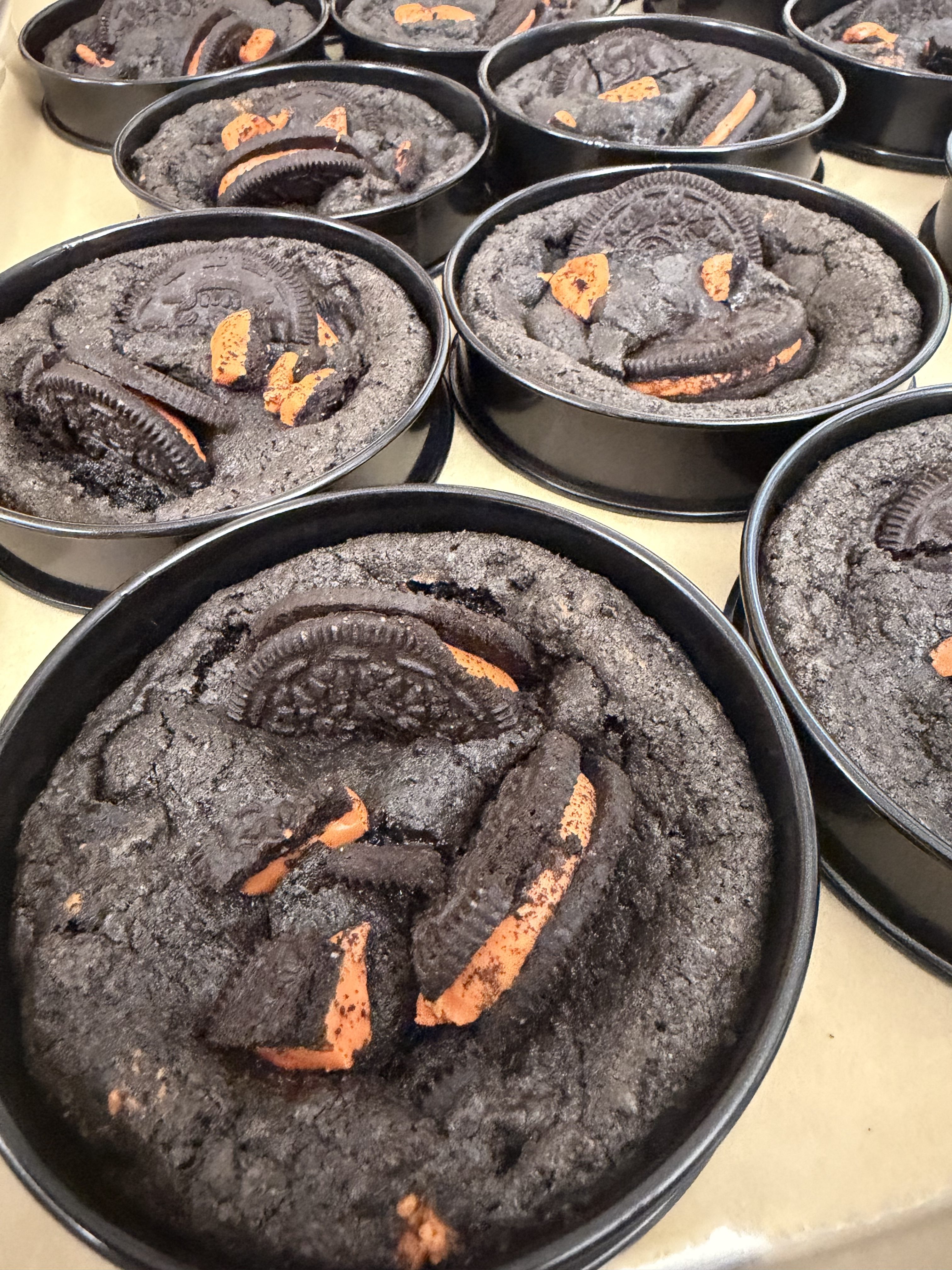
My idea seemed simple enough: What if I could make an Oreo-packed chocolate cookie that was really dark? Not just regular chocolate-cookie brown, but that dramatic, almost-black color that would be perfect for Halloween.
That little experiment introduced me to black cocoa powder.
And I am officially hooked.
What Is Black Cocoa Powder?
If you’ve never baked with black cocoa powder before, you’re definitely not alone. Judging by the response I received after sharing my cookies online, there are quite a few of us who didn’t realize this ingredient existed!
Black cocoa is a heavily alkalized—or Dutch-processed—cocoa powder. The additional alkalization reduces some of cocoa’s natural acidity and gives it an incredibly dark color along with a smooth, distinctive chocolate flavor.
If the taste seems familiar, there’s a reason. That deep, dark cocoa flavor is closely associated with the flavor profile people recognize in very dark chocolate sandwich cookies.
In other words, when I decided to add it to my Super Oreo Cookies, I couldn’t have picked a more appropriate ingredient.
My First Reaction: WOW, That Is Black
Opening the bag was an experience all by itself.
I’ve purchased plenty of products where the photograph on the package looks dramatically different from what’s actually inside.
Not this time.
There was definitely truth in advertising with this particular product.
I opened the bag and immediately thought, WOW.
It really was black.
Not dark brown.
Not “maybe it’ll look black after it’s baked.”
Black.
Suddenly, my spooky-season cookie experiment was looking very promising.

Watching the Dough Transform
One of my favorite parts of baking is watching individual ingredients transform into something completely different, and black cocoa powder made that process especially fun.
As I incorporated it into the flour, I could immediately see how dramatically it changed the mixture.
Then came the dough.
The darker it became, the more excited I got.
Once everything was completely mixed and the Oreos were incorporated, I knew these weren’t going to look like ordinary chocolate cookies.
And when I started shaping the dough into individual cookies, I had that feeling bakers sometimes get before something even goes into the oven:
These are going to be good.
Then I Added Espresso
Because I really wanted to capitalize on the chocolate flavor, I decided to add another little ingredient to the recipe:
Espresso.
Coffee and chocolate are one of those combinations that work incredibly well together, even when you don’t necessarily want your dessert to taste like coffee.
A small amount of espresso can intensify our perception of chocolate’s roasted, rich flavors. Coffee and cocoa share many complementary roasted flavor compounds, so adding a little espresso can make the chocolate seem deeper and more complex.
The important part is a little.
I wasn’t trying to make a mocha cookie or an espresso cookie. I wanted the chocolate to remain the star.
The espresso was there in the background, essentially saying:
“Hey, chocolate. Let me help you out.”
And it worked.

Black Cocoa + Espresso + Oreos = Something Special
The finished cookies were exactly what I had hoped for—and maybe even better.
They were incredibly dark, dramatic and absolutely perfect for spooky season. The black cocoa created that unmistakable dark-cookie appearance, while the espresso helped emphasize the rich chocolate notes.
Then, of course, there were the Oreos.
Put everything together and my familiar Super Oreo Cookie suddenly became something completely different.
The result was our new Black Cocoa Powder Oreo Cookies, and of course I had to use the Halloween Oreos with the orange filling.
And they are definitely going to be making more appearances at the farmstand.
Apparently, I Wasn’t the Only One Who Didn’t Know About Black Cocoa
Of course, when I get excited about something on the homestead, I tend to share it.
So I made a video showing the cookies and posted it online.
The response surprised me.
People were fascinated by the black cocoa powder!
There were comments from people who had never heard of it, people who couldn’t believe how dark the cookies were, and others who were just as intrigued by the ingredient as I had been when I opened that bag.
Apparently, I wasn’t alone.
There are a whole bunch of us out here baking with regular cocoa powder who had no idea what we were missing.
That’s one of the things I love about sharing our adventures at J & J Homestead. Sometimes I’m teaching something I’ve learned through years of experience.
Other times?
We’re all discovering something together.
This was definitely one of those times.
Is Black Cocoa Powder the Same as Regular Cocoa Powder?
Not exactly, and that’s important if you’re thinking about experimenting with it yourself.
Black cocoa is much more heavily alkalized than natural cocoa powder, which changes both its flavor and its chemistry. It tends to have a smoother, less acidic cocoa flavor and doesn’t behave exactly like natural cocoa in every recipe.
That means I wouldn’t automatically replace all the cocoa powder in every recipe with black cocoa and expect identical results.
Depending on the recipe, combining black cocoa with regular Dutch-process or natural cocoa can also be a great option. You can get some of that spectacular dark color and distinctive flavor without completely changing the character of your original recipe.
Like so many things in baking, experimentation is part of the fun.
Perfect for Halloween and Spooky-Season Baking
Now that I’ve discovered it, my mind is already racing with possibilities.
Black cocoa powder would be amazing for Halloween cookies, cupcakes, brownies, cakes, sandwich cookies, frostings and all kinds of spooky desserts.
Imagine black cocoa cookies with orange or purple accents. Or a nearly black cupcake topped with bright buttercream. Or dark brownies decorated with little candy eyes.
It’s one of those ingredients that gives you flavor and visual impact without having to rely entirely on food coloring to create a dramatic dark dessert.
For a home baker, that’s pretty exciting.
Another Farmstand Experiment Becomes a Favorite
One of the most enjoyable parts of running our little farmstand is getting to experiment.
Some recipes are family favorites we’ve made over and over again. Others start with a random thought in the kitchen:
“I wonder what would happen if I tried this…”
That’s exactly how these cookies happened.
I wanted something fun for spooky season.
I discovered black cocoa powder.
I opened the bag and couldn’t believe how dark it was.
I mixed it into the flour.
I watched my cookie dough turn nearly black.
I added a little espresso to deepen the chocolate flavor.
And by the time I shaped those cookies and put them into the oven, I knew I had stumbled onto something special.
Then I shared the experiment online and discovered that so many other people were learning about black cocoa powder right along with me.
This is why I love experimenting in the kitchen.
Sometimes the simplest ingredient can take a recipe you’ve made countless times and make it feel completely new again.
And I can confidently say one thing:
Black cocoa powder has officially earned a permanent spot in my baking pantry.
Now I just have to figure out what I’m going to make with it next.



Leave a Reply