
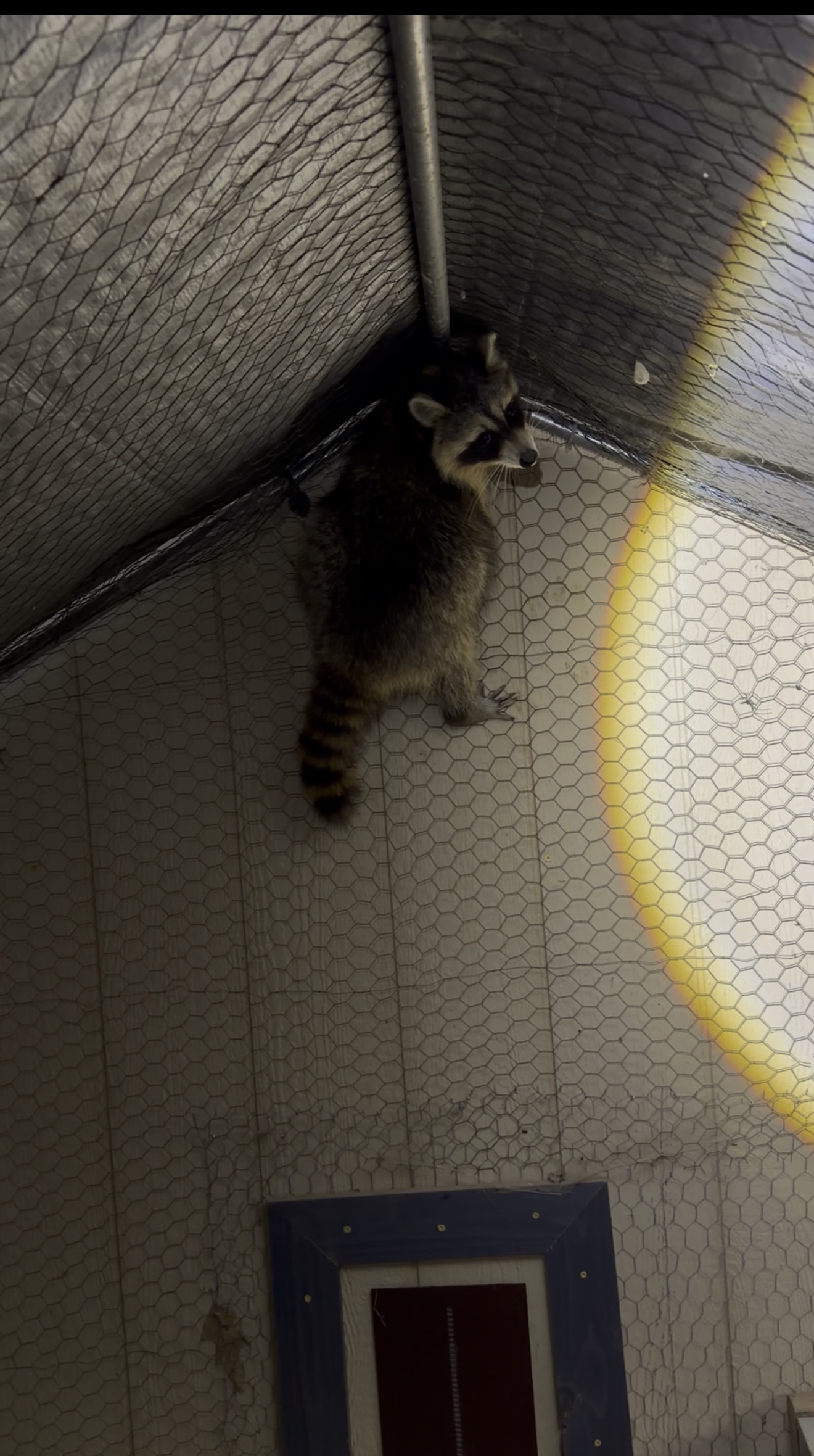
This morning, we discovered signs of a raccoon in our chicken run. And while raccoons might be some of the cutest little creatures in the woods, they’re also one of the most dangerous predators a backyard chicken keeper can encounter.
There’s something about those little masked faces, tiny hands, and fluffy striped tails that makes raccoons almost impossible not to love.
Almost.
Because when you’re a chicken keeper, seeing evidence that a raccoon has been visiting your flock is anything but adorable.
This morning at J & J Homestead, we discovered signs that a raccoon had been in our chicken run. And immediately, my mind went to all the terrible things that could have happened.
We’ve worked incredibly hard to provide our chickens and turkeys with safe, comfortable living environments. Because predators are such a concern in our area, we don’t allow our chickens to free-range. Instead, they have dedicated runs where they can scratch, dust bathe, explore, and enjoy their days.
But here’s the frightening reality of raising poultry: Even when you think you’ve done everything right, predators can still find a way in.
And raccoons are particularly good at finding weaknesses.
Today, I want to share why raccoons are such a serious threat to backyard chickens, what signs you should look for, and how you can better protect your flock.
Why Are Raccoons So Dangerous to Chickens?
Raccoons are intelligent, resourceful, and surprisingly strong animals. They’re also opportunistic omnivores, meaning they’ll eat just about anything they can get their paws on.
Unfortunately, that includes our chickens, chicks, and eggs.
Unlike some predators that may grab a single chicken and disappear, raccoons can injure or kill multiple birds during a single visit.
Here are a few reasons they’re particularly dangerous.
1. Raccoons Are Remarkably Intelligent
Raccoons are natural problem-solvers.
They can manipulate objects, investigate openings, climb fences, and sometimes figure out simple latches.
That little dexterity that makes them so cute when they’re washing or handling food becomes a serious problem when they’re investigating a chicken coop.
A basic hook-and-eye latch or a loosely secured door may not provide adequate protection.
Our takeaway: If a latch can easily be manipulated or bumped open, it’s time to upgrade to something more secure.
2. Raccoons Can Reach Through Chicken Wire
This is one of the most disturbing things about raccoon attacks.
A raccoon doesn’t necessarily need to enter the coop to harm a chicken.
Raccoons can reach through large openings in wire fencing, grab a chicken, and cause devastating injuries.
Chickens that sleep close to the sides of a run or coop can be especially vulnerable.
And here’s something that surprises many new chicken keepers:
Chicken wire is designed primarily to contain chickens, not to keep determined predators out.
Its thin wire can be damaged or pulled apart, and its openings may allow a raccoon to reach through.
For predator protection, properly installed galvanized hardware cloth with ½-inch openings is generally a much better option.
3. Raccoons Are Excellent Climbers
Think your chickens are safe because their run has tall fencing?
Unfortunately, raccoons are excellent climbers.
They can scale wooden fencing, climb trees, and navigate structures that seem nearly impossible.
An uncovered run may be an invitation to a determined raccoon.
This is one reason a securely covered chicken run is so important, particularly when your flock lives in an area with a significant predator population.
4. Raccoons Are Primarily Active at Night
Raccoons are generally nocturnal, although seeing one during the day doesn’t automatically mean it’s sick.
For chicken keepers, nighttime is particularly concerning because our birds are sleeping.
When chickens roost, they become much less aware of their surroundings and have fewer opportunities to escape.
A raccoon that gains access to a coop at night may encounter an entire flock of vulnerable birds.
And by the time you discover what happened the following morning, the damage may already be done.
5. One Raccoon Can Cause Multiple Casualties
Perhaps the most heartbreaking part of a raccoon attack is that the damage isn’t always limited to one bird.
Raccoons may kill multiple chickens, particularly when birds are confined and cannot escape.
Even chickens that survive an attack can suffer serious injuries, stress, and secondary infections.
For anyone who has raised chickens from tiny chicks, watched their personalities develop, and cared for them every day, the thought of losing several birds in a single night is devastating.
Our chickens aren’t just egg producers.
They’re living creatures that depend on us for their safety.
Signs a Raccoon Has Been Visiting Your Chicken Coop and Run
Finding evidence of a predator before an attack gives you an opportunity to reinforce your defenses.
Some common signs of raccoon activity include:
- Tracks: Small, hand-like footprints with five distinct toes.
- Disturbed feed: Feeders knocked over, spilled grain, or missing food.
- Damaged fencing: Bent wire, loosened staples, or signs of pulling around openings.
- Tampered latches: Doors or access panels that appear to have been manipulated.
- Droppings: Raccoon scat may appear near fences, feeding areas, or travel routes.
- Disturbed bedding or nesting areas: Particularly if accompanied by other evidence of an animal entering.
It’s important to remember that these signs aren’t always unique to raccoons. Other animals can create similar disturbances.
A trail camera is an excellent way to confirm exactly what’s visiting your chicken run after dark.
Important safety note: Avoid touching raccoon droppings. They can carry raccoon roundworm, which poses a serious health risk to people. Suspected contaminated areas should be handled using appropriate protective precautions.
How to Raccoon-Proof Your Chicken Coop and Run
After discovering signs of a raccoon this morning, predator protection is certainly at the forefront of my thoughts.
Here are some of the most important ways to protect backyard chickens.
1. Replace Vulnerable Chicken Wire With Hardware Cloth
One of the best improvements you can make is installing ½-inch galvanized hardware cloth over vulnerable areas.
Pay particular attention to doors, windows, ventilation openings, and the lower portions of your run.
Secure it with screws and washers or wooden battens rather than relying on ordinary staples alone.
2. Secure Every Door and Latch
Raccoons are surprisingly skilled at manipulating simple closures.
Consider using locking carabiners, padlocks, or secure two-step latching systems.
Don’t forget nesting box doors, feed storage areas, and maintenance access panels.
3. Protect Against Digging Predators
While raccoons are known for climbing, you should also protect your run against animals that dig.
An outward-facing hardware-cloth apron, generally extending 12–24 inches around the perimeter, can help discourage predators from tunneling underneath.
4. Secure the Roof of Your Run
A tall fence alone isn’t enough.
A sturdy, predator-resistant roof or securely fastened wire covering can help prevent climbing predators from entering.
Lightweight bird netting may keep wild birds out, but it isn’t reliable protection against raccoons.
5. Remove Food Attractants
Raccoons have an excellent sense of smell, and readily available food may encourage them to return.
Store poultry feed in tightly secured containers, clean up spilled grain, remove uneaten treats at night, and avoid leaving accessible garbage nearby.
6. Lock Chickens Inside a Secure Coop at Night
This is one of the most important habits you can establish.
Even if your run seems secure, an enclosed, predator-resistant coop provides an additional layer of protection.
Automatic coop doors can be helpful, but they must close reliably after every bird has entered.
7. Consider Trail Cameras and Motion-Activated Lights
Trail cameras can help you identify which predators are visiting and where they’re entering.
Motion-activated lights may discourage some visitors, but raccoons can become accustomed to them. They should never replace physical barriers.
What Should You Do If You Find Signs of a Raccoon?
If you discover evidence of a raccoon around your chickens, don’t wait for an attack to take action.
Here is a practical checklist for that same day.
Raccoon Alert: Coop Safety Checklist
0 of 7 completedAccount for every chicken and check for injuriesInspect the run for gaps, loose wire, damaged doors, and diggingSecure all birds inside a predator-resistant coop before darkRemove spilled feed and any leftover treatsReinforce vulnerable openings and upgrade weak latchesSet up a trail camera to identify nighttime visitorsCheck the run again the following morning
Copy checklist
If you find an injured chicken, separate it safely, assess the wounds, and contact a poultry veterinarian promptly. Predator bites and puncture wounds can cause serious internal damage and infection even when the external injuries look small.
Never attempt to corner, handle, or capture a raccoon yourself. If an animal is behaving abnormally or appears sick, keep your distance and contact local animal control or wildlife authorities.
Can Raccoons Carry Diseases That Affect Your Chickens?
Beyond the immediate danger of an attack, raccoons can introduce other concerns to a poultry environment.
They may carry parasites and pathogens, contaminate feed or water with feces, and attract additional wildlife activity around your coop.
Raccoons are also a recognized rabies reservoir in parts of the eastern United States. Although birds do not contract rabies, the disease is a serious concern for people and other mammals that may come into contact with an infected raccoon.
This makes preventing wildlife access important for the safety of the entire homestead, not just the chickens.
Why Predator Prevention Matters So Much on Our Homestead
One of the lessons we’ve learned through raising chickens, turkeys, and other animals is that homesteading comes with an enormous responsibility.
We choose to bring these animals into our lives.
We provide their food, shelter, and care.
And we do everything we can to keep them safe.
Because predator pressure is such a significant concern where we live, we’ve made the decision to keep our poultry in enclosed runs rather than allowing them to free-range.
That decision comes with additional work.
We’re constantly cleaning runs, adding enrichment, maintaining fencing, checking doors, and making improvements.
But we do those things because we believe our animals deserve a safe environment.
And even with all those precautions, mornings like today remind us that there is always room to improve.
One small weakness in a fence, one unsecured latch, or one overlooked opening can be all it takes.
Can You Keep Raccoons Away Without Harming Them?
Absolutely. And whenever possible, that’s the approach we prefer.
Raccoons are simply wild animals trying to survive. They’re not malicious, and they certainly don’t understand how much we love our chickens.
They’re doing what comes naturally.
Our responsibility is to make sure they cannot access our animals.
Strong fencing, secure coops, proper feed storage, and eliminating easy entry points are much more dependable long-term strategies than attempting to frighten raccoons away.
If you have persistent problems, your local wildlife agency or a qualified wildlife professional can provide guidance on lawful, humane management options.
The Hard Truth About Raising Chickens: We Can’t Eliminate Every Risk
I wish I could say that after years of raising poultry, we’ve figured out how to protect our birds from absolutely everything.
But that’s simply not how homesteading works.
There will always be something new to learn, something to improve, and something unexpected waiting around the corner.
Some days, the lessons are wonderful.
A new chick hatches. A pullet lays her first egg. A favorite hen comes running to greet you.
And other days, you wake up and discover evidence that a raccoon has been exploring your chicken run.
Those are the mornings that remind you how quickly things can change.
But they also remind us why we do what we do.
We don’t raise chickens because it’s easy.
We raise them because we love the experience, the connection to our food, and the opportunity to care for these incredible animals.
And sometimes, caring for them means taking a hard look at the things we thought were secure and making them even better.
Final Thoughts: Cute Doesn’t Always Mean Harmless
I still think raccoons are adorable.
I really do.
Those little masked faces and clever hands are fascinating.
But I’d much rather admire one in the woods than discover it anywhere near our chickens.
This morning was an important reminder that predator protection isn’t something you do once and forget about. It’s an ongoing part of responsible chicken keeping.
So today, we’ll be paying extra attention to our fencing, doors, and any potential access points.
Because our chickens are counting on us.
And that’s a responsibility we take seriously.
Thank you for learning alongside us at J & J Homestead!
Have you ever had a raccoon visit your chicken coop? What did you do to keep your flock safe? We’d love to hear your experiences and tips in the comments!



Leave a Reply