

There is something about walking through the grocery store and finding myself shopping for the chickens and turkeys instead of the humans in our house!
Does anyone else do this?
I might head into the store with every intention of picking up a few things for dinner, but before I know it, I’m standing in the produce section looking at cabbage, kale, blueberries, and zucchini, thinking about how much our feathered friends would enjoy them.
And you know what? I absolutely love it!
Here at J & J Homestead, we believe that caring for our chickens and turkeys goes well beyond providing a safe coop, fresh water, and quality feed. We also want them to have opportunities to explore, forage, and enjoy their days.
Because our chickens and turkeys live in enclosed runs to protect them from predators, enrichment is especially important to us.
One of the easiest ways we’ve found to provide that enrichment is through something as simple as grocery store treats!
Today, we’re sharing some of our favorite foods to pick up for our chickens and turkeys, why they’re beneficial, and how we serve them to keep our birds happy, healthy, and entertained.
Why Give Chickens and Turkeys Treats?
Before we get into our grocery shopping list, let’s talk about why treats can be such a wonderful addition to your poultry care routine.
Chickens and turkeys are naturally curious animals. In the wild, they spend a considerable amount of their time scratching, pecking, exploring, and searching for food.
When birds are kept in enclosed runs, as ours are, we have to be a little more creative about providing those opportunities.
That’s where enrichment treats come in!
Offering different fruits, vegetables, and occasional protein-rich snacks can help:
- Encourage natural foraging behaviors. Scattering treats gives birds something to search for and investigate.
- Reduce boredom. Hanging vegetables and introducing new textures can keep curious birds occupied.
- Provide nutritional variety. Fresh produce can contribute vitamins, minerals, and other beneficial nutrients.
- Encourage movement. Spreading treats around the run encourages birds to walk and explore.
- Support positive flock interactions. Multiple feeding locations can help reduce competition over special treats.
Of course, treats should never replace a balanced poultry feed. Our birds still receive their regular feed every day, and treats are simply a little something extra.
A good guideline is to keep treats at approximately 10% or less of their daily diet.
1. Cabbage: One of the Best Enrichment Treats for Chickens and Turkeys
If I could recommend just one grocery store vegetable for poultry enrichment, cabbage would be near the top of my list.
Not only is it relatively inexpensive, but it can provide an incredible amount of entertainment.
One of my favorite ways to offer cabbage is to hang it securely inside the run, where the birds can peck at the leaves.
It becomes a wonderful little activity!
Cabbage provides fiber, vitamin C, and vitamin K, although chickens and turkeys generally produce their own vitamin C under normal conditions.
How to serve it: Hang a cabbage securely at a comfortable pecking height, or cut it into manageable pieces and distribute it around the run. Avoid loose strings that birds could become tangled in.
For our larger turkeys, offering sturdy pieces of cabbage can be especially entertaining.
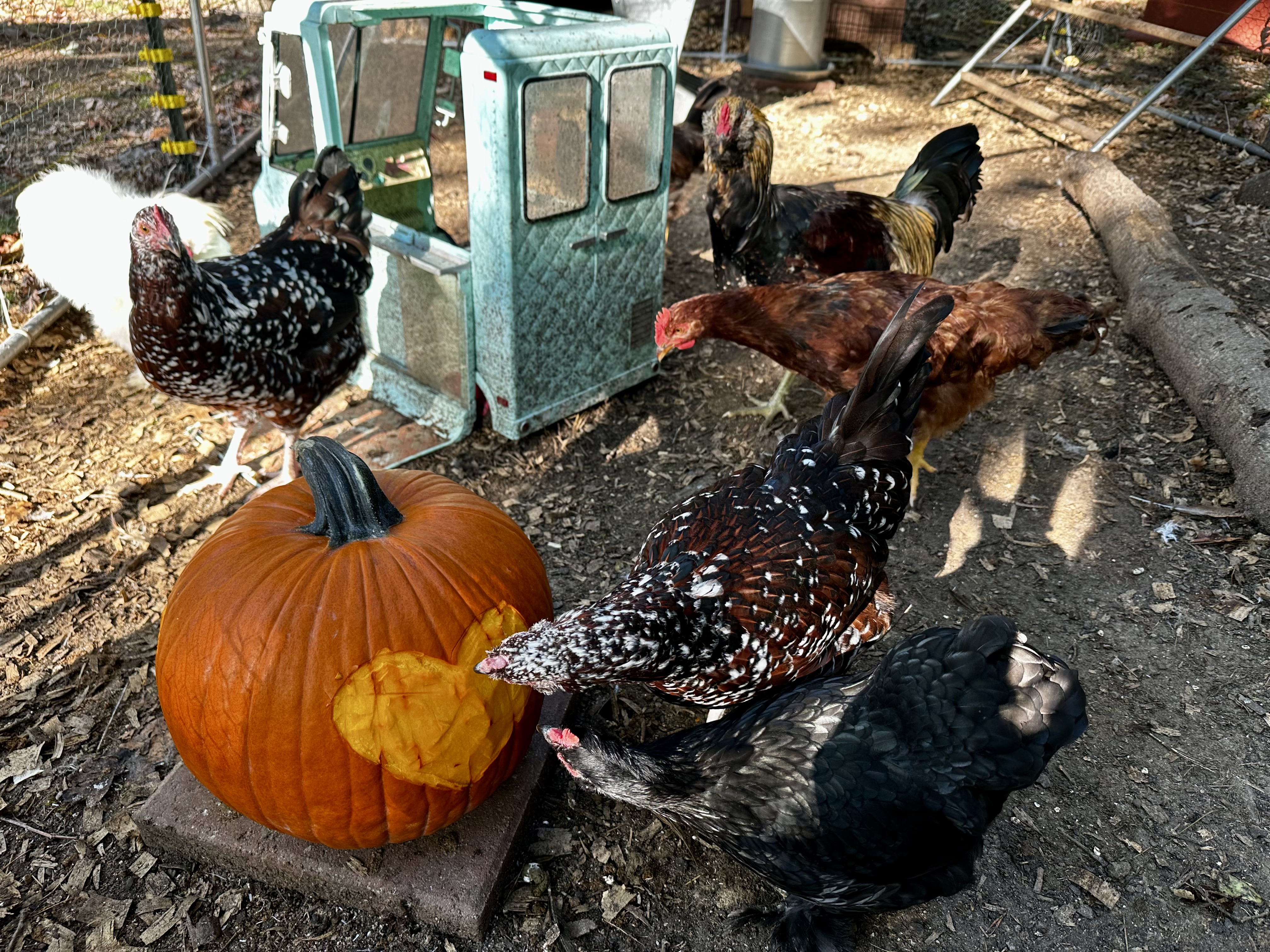
2. Pumpkin! The perfect Fall treat!
With fall in full swing, pumpkins are everywhere!
And the good news is that chickens and turkeys can enjoy them, too.
Pumpkin flesh contains beta-carotene, which the body can convert to vitamin A, along with fiber and moisture.
The seeds are also edible and contain fats and protein.
One of the easiest ways to serve pumpkin is to cut it in half and place it inside the run. The birds can investigate it, peck at the flesh, and work their way through the seeds.
A quick note about pumpkin seeds and worms: You may have heard that pumpkin seeds are a natural dewormer for chickens. While this is a popular homesteading belief, there is not sufficient evidence that feeding pumpkin seeds reliably treats intestinal parasites in poultry.
Pumpkin is a wonderful treat, but it should never replace proper parasite testing or veterinary treatment when needed.
3. Leafy Greens: Kale, Romaine Lettuce, and More
Leafy greens are another grocery store favorite!
We regularly offer our chickens and turkeys greens, and they are always excited to investigate whatever we bring into their runs.
Some great options include kale, romaine lettuce, Swiss chard, and small amounts of spinach.
Kale is particularly useful because it contains vitamin K, carotenoids, and other nutrients.
Romaine lettuce is another excellent choice, especially when you want something with a little more moisture.
How to serve them: Chop greens into manageable pieces, hang whole leaves for pecking, or scatter them around the run.
We often combine greens with other vegetables to create a little foraging buffet.
It’s amazing how something so simple can keep the birds busy!
4. Zucchini and Cucumbers: Easy, Affordable Poultry Treats
If you’ve followed our homesteading adventures for any length of time, you know that zucchini is a familiar sight around here!
During the growing season, our garden provides plenty of it.
But when the garden slows down, there’s absolutely nothing wrong with picking some up at the grocery store.
Zucchini and cucumbers are both high in water and relatively low in calories.
They’re easy to prepare and generally well tolerated by chickens and turkeys.
I like to cut zucchini into small pieces or rounds so the birds can pick them up easily.
For larger turkeys, you can also cut a zucchini lengthwise and let them peck at the exposed flesh.
These are particularly nice treats during warmer weather, although our birds enjoy them throughout the year.
5. Broccoli: A Nutritious Vegetable With Plenty of Texture
Broccoli is another excellent addition to your poultry shopping cart.
It contains vitamin K, folate, fiber, and various plant compounds.
But what makes broccoli especially fun is its texture!
The florets give chickens and turkeys something interesting to peck at, while the stems can be chopped into smaller pieces.
Try offering broccoli in several different ways.
You might scatter small florets around the run one day and offer larger pieces the next.
Sometimes simply changing how a familiar treat is presented can make it interesting all over again.
A Special Treat Buffet for Turkeys!
This is our first winter caring for a larger flock of turkeys, and one thing I’ve learned is just how curious these birds can be!
They love investigating their surroundings.
And because turkeys are considerably larger than chickens, I like to think about how we can adapt their enrichment activities to their size and behavior.
One idea I particularly love is creating a turkey treat buffet.
Instead of placing everything in a single bowl, distribute small portions of different foods around the run.
For example, you might offer chopped kale in one location, broccoli florets in another, and zucchini pieces somewhere else.
Add a few blueberries for a special surprise!
This encourages the turkeys to move around, investigate different areas, and engage in natural foraging behaviors.
Just make sure you’re not creating competition by placing too much food in one location.
For large flocks, multiple treat stations are especially helpful.
Don’t Forget About Grit!
One important consideration when feeding chickens and turkeys fruits, vegetables, and other treats is grit.
Chickens and turkeys don’t have teeth.
Instead, they rely on their muscular gizzard to grind up food, with insoluble grit helping to break down fibrous and other coarse materials.
Because our birds live in enclosed runs, we make sure they have access to appropriately sized poultry grit.
This is especially important when they’re eating foods beyond their regular commercial feed.
Chickens and turkeys may need different grit sizes depending on their age and size, so choose an appropriate product.
And remember, oyster shell is not a substitute for insoluble grit. Oyster shell supplies calcium for laying birds, while grit helps with grinding food.
The Most Important Ingredient? A Little Creativity!
One of the things I’ve come to appreciate most about homesteading is that it doesn’t always take something expensive or complicated to make a difference.
Sometimes it’s as simple as a head of cabbage.
Or a handful of blueberries.
Or taking a few extra minutes in the morning to chop up vegetables for the chickens and turkeys.
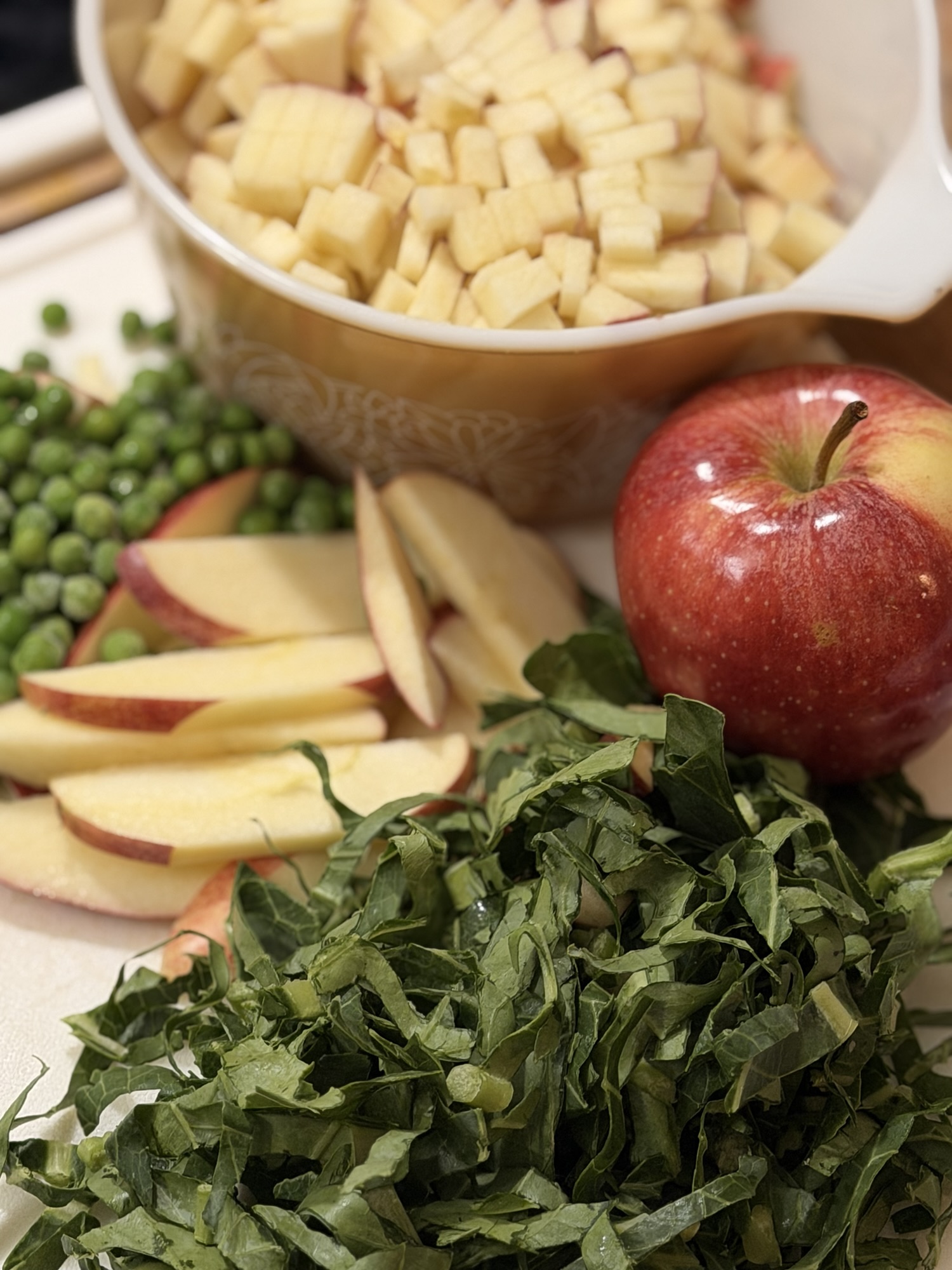
Every morning, as I make my rounds around the homestead, I enjoy preparing little treats for our birds. Apples, greens, zucchini, and thawed peas have all made appearances in their runs.
And while I know these treats provide nutritional variety, what I love most is watching the birds investigate them.
Some immediately come running.
Others are a little more suspicious.
And then there are those chickens who seem convinced that whatever another chicken has must be better than what’s sitting right in front of them!
If you’ve kept chickens for any length of time, you know exactly what I’m talking about.
These are the little moments that make homesteading so enjoyable.
As we move into the colder months, I’m especially mindful of providing enrichment for our flock. With fewer hours of daylight, colder temperatures, and less activity in the garden, I want to make sure our birds still have plenty of opportunities to stay active and curious.
And if that means adding a few extra vegetables to my grocery cart?
Well, I’m certainly not going to complain!
Leave a Reply