

If you’ve walked out to the chicken coop lately and thought, “Wait…where are all the eggs?” you’re definitely not alone.
Late summer can be a confusing time for backyard chicken keepers. Your hens may look perfectly healthy. They’re eating, drinking, scratching around, and waiting impatiently for treats—but suddenly there aren’t nearly as many eggs in the nesting boxes.
For many chicken keepers, this seasonal slowdown starts becoming noticeable in late August and September.
And while cooler weather often gets blamed, temperature usually isn’t the biggest reason. Daylight is.
Let’s talk about when chicken egg production typically slows down, why it happens, what you can expect through fall and winter, and what you should—and shouldn’t—do with your flock’s feed when the eggs start disappearing.
When Do Chickens Slow Down Laying Eggs?
Chicken egg production generally begins slowing during late summer and early fall, often starting sometime between August and September. By October and November, the decline can become much more obvious.
That’s because chickens are naturally seasonal layers. Their reproductive systems respond strongly to the number of daylight hours they receive each day. Most laying hens perform best with approximately 14–16 hours of light per day.
After the summer solstice, our days gradually become shorter. At first, the difference isn’t particularly noticeable to us. Your chickens notice.
As daylight continues decreasing through August, September, and October, the hormonal signals responsible for egg production begin changing.
The result?
Fewer eggs in the nesting boxes.
A Simple Chicken Egg Production Calendar
While every flock is different, here’s a general idea of what you might see throughout the year.
Spring: Egg Production Takes Off
Spring is one of the most exciting times to keep laying hens.
As daylight increases, egg production generally increases with it.
Depending on breed, age, nutrition, and health, many hens will be laying consistently by March and April.
Early Summer: Peak Egg-Laying Season
Late spring and early summer are often some of the most productive months of the year. Long days provide plenty of natural light, and healthy laying hens may produce eggs very consistently.
Of course, extremely hot weather can temporarily interfere with that.
Heat stress can reduce feed consumption, increase water requirements, and sometimes cause egg production to decline even during otherwise excellent laying months.
Late August–September: The Slowdown Begins
This is when things start getting interesting. The days are getting shorter, even though afternoon temperatures may still feel very much like summer.
You may start noticing:
- Fewer eggs each day
- Longer gaps between eggs from individual hens
- Feathers appearing around the coop and run
- Hens beginning to look a little ragged
- Older hens slowing down before younger birds
Don’t immediately assume something is wrong. You may simply be seeing the beginning of the normal seasonal transition.
September–November: Molting Season Arrives
Then comes the molt.
If you’ve never experienced a flock-wide molt before, it can look alarming. Suddenly there are feathers everywhere. Some chickens look like someone partially plucked them overnight.
Molting is the natural process through which chickens shed old feathers and grow new ones. Growing an entirely new set of feathers requires significant amounts of energy and protein.
Something has to give. Frequently, that’s egg production.
Some hens will continue producing occasional eggs while molting. Others may stop laying altogether for a period of time.
This isn’t necessarily a problem. Their bodies are simply prioritizing feather production over egg production.
November–January: The Winter Egg Slump
For naturally managed flocks without supplemental lighting, late fall and early winter can bring the lowest egg production of the year.
December has some of the shortest days of the year, which means hens receive considerably less natural light than they did during spring and summer.
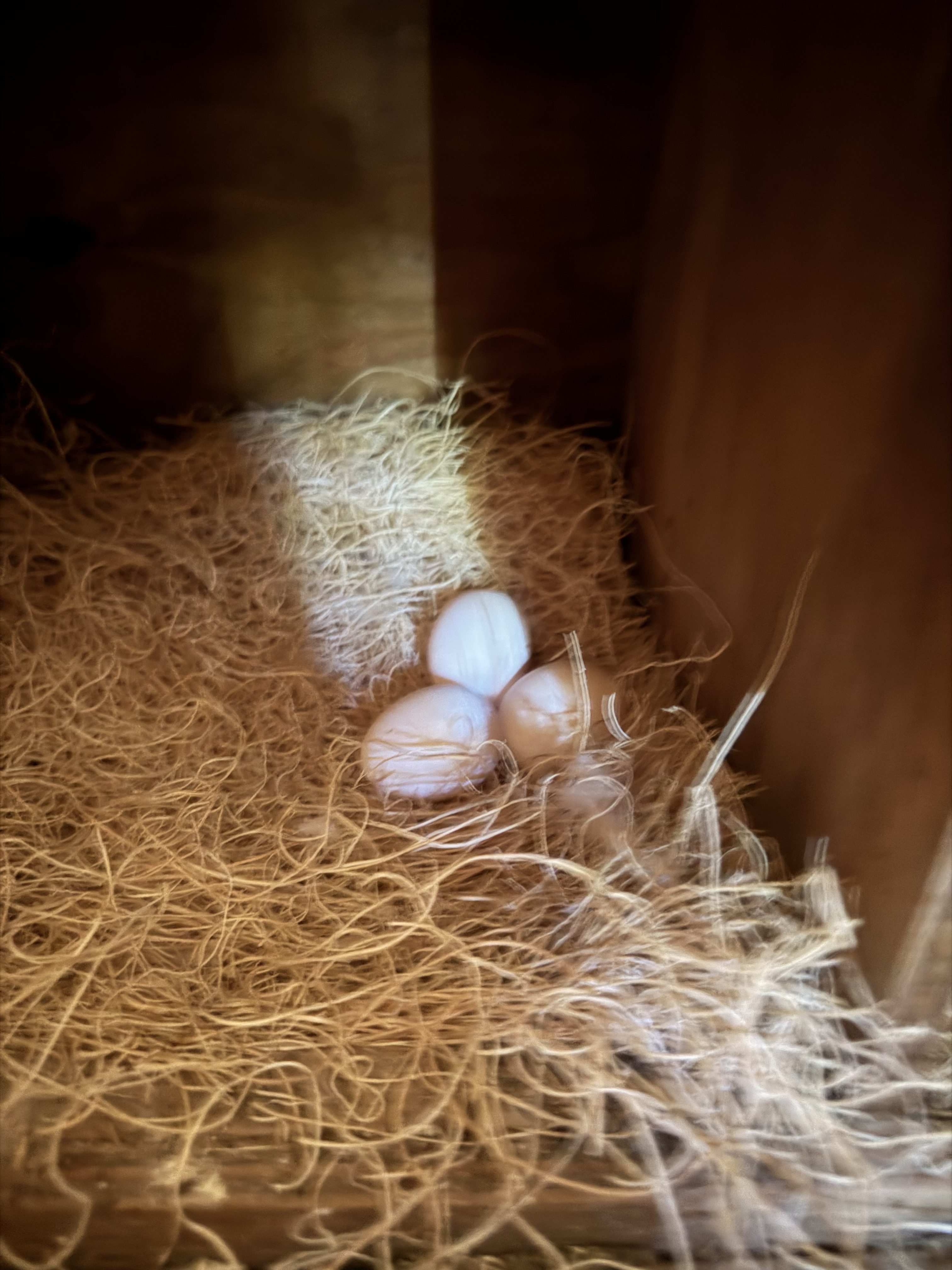
You might find yourself staring into an empty nesting box thinking:
I’m feeding all these chickens…for three eggs?!
Welcome to winter chicken keeping.
February–March: Eggs Start Coming Back
Then something wonderful happens.
The days begin getting longer.
Gradually, egg production starts increasing again.
You might collect four eggs one week, six the next, and suddenly realize the nesting boxes are filling again.
Spring is coming—and the chickens know it before we do.
Why Does Daylight Affect Chicken Egg Production?
A hen’s reproductive system is heavily influenced by light.
Light entering through the hen’s eyes stimulates hormonal activity involving the brain and reproductive system. Increasing daylight encourages reproductive activity, while decreasing daylight signals that winter is approaching.
From an evolutionary standpoint, that makes perfect sense.
Spring and summer traditionally provide better conditions for raising chicks:
- Longer days
- Warmer temperatures
- More insects
- More vegetation
- Greater natural food availability
Winter isn’t exactly ideal chick-raising season.
Modern chickens have been selectively bred to produce considerably more eggs than their ancestors, but those basic biological responses haven’t disappeared.
How Much Daylight Do Chickens Need to Lay Eggs?
For consistent production, laying hens generally perform best with approximately 14–16 hours of light per day.
During spring and summer, nature provides much of that.
During winter, it doesn’t.
Some chicken keepers add supplemental lighting to their coops to maintain winter egg production.
Others choose to let their hens follow their natural seasonal rhythm.
There are arguments for both approaches.
On our homestead, I’m increasingly interested in understanding what the chickens naturally do throughout the year rather than assuming every decrease in production means something needs to be fixed.
Sometimes fewer eggs aren’t a problem.
They’re simply part of keeping chickens.
Molting Can Dramatically Reduce Egg Production
Daylight isn’t the only thing happening in the fall.
Many mature chickens undergo their annual molt during this same period.
And feathers require a lot of protein.
Feathers are primarily composed of keratin, a protein that requires amino acids to produce. When a chicken is replacing hundreds or thousands of feathers, her nutritional resources are being redirected.
That means her body may essentially decide:
We’re growing feathers right now. Eggs can wait.
This is one reason fall nutrition is so important.
Should You Feed Chickens Less When They Stop Laying?
This is an important one:
Don’t dramatically reduce your chickens’ complete feed simply because they’re producing fewer eggs.
It can be tempting.
When you’re feeding a large flock and collecting fewer eggs, you suddenly become very aware of how much that feed costs!
But your chickens still need balanced nutrition.
And during molt, they’re actually undergoing an extremely nutritionally demanding process.
Instead of cutting their primary feed, look at the extras.
Scratch grains, cracked corn, table scraps, mealworms, and other treats can add up quickly.
Chickens love them.
Unfortunately, chickens don’t always make nutritionally responsible decisions.
Given the choice between balanced poultry feed and a pile of scratch grains, many chickens will happily fill themselves with scratch.
Sound familiar?
The goal should be to make a complete, nutritionally appropriate poultry ration the foundation of the diet, while keeping treats and scratch grains limited.
Young Hens May Lay Through Their First Winter
Here’s another interesting wrinkle.
Not every chicken will follow exactly the same seasonal schedule.
Pullets often lay surprisingly well during their first winter.
If your young hens reached laying age during summer or early fall, they may continue producing eggs while your older hens are molting and taking their winter break.
That’s one reason a mixed-age flock can be beneficial.
Your nesting boxes might contain:
Older hens: “See you in March.”
Pullets: “I got this.”
Breed matters, too.
High-production breeds such as Leghorns and other prolific egg layers may continue producing more consistently than breeds that haven’t been selected as heavily for egg production.
Other Reasons Chickens Suddenly Stop Laying Eggs
Seasonal changes are normal, but you shouldn’t automatically assume every production decrease is caused by daylight.
Sudden egg-production changes can also be associated with:
- Extreme heat
- Inadequate nutrition
- Insufficient water
- Parasites
- Illness
- Stress
- Predator activity
- Changes within the flock
- Moving chickens
- Bullying
- Broodiness
- Molting
- Age
- Hidden nests
That’s why knowing your flock’s normal behavior is so important.
If your hens are active, eating normally, drinking normally, maintaining appropriate body condition, and otherwise behaving normally, a gradual fall decrease in eggs is often simply seasonal.
A dramatic overnight change accompanied by sick or unusual behavior deserves closer attention.
Older Hens Naturally Produce Fewer Eggs
Season isn’t the only factor.
Age matters.
Most hens are at their highest production levels during their first few laying years. Production gradually decreases as chickens get older.
An older hen may still produce eggs for many years, but she probably won’t produce as frequently as a young hen.
This becomes particularly noticeable when comparing generations within the same flock.
Your younger birds may be filling the nesting boxes while your veteran hens are taking increasingly generous vacations.
The Feed-to-Egg Ratio Gets Interesting in Winter
This is something we’re paying more attention to on the homestead.
It’s easy to calculate what a bag of chicken feed costs.
What’s harder to see is:
How much feed are we actually using to produce a dozen eggs?
Imagine a flock eating roughly the same amount of feed while production changes from 25–30 eggs per day during peak season to a fraction of that during winter.
Suddenly the cost of producing each dozen eggs changes considerably.
That’s why late summer is a fantastic time to start tracking:
- Pounds of feed purchased
- Pounds of feed consumed
- Number of chickens
- Eggs collected each day
- Eggs collected each week
- Feed cost
- Cost per dozen eggs
Keep those records through winter and into spring.
You’ll develop a much better picture of the true economics of keeping laying hens.
And if you sell eggs from your homestead or farmstand, that information becomes even more valuable.
Should You Add Supplemental Light During Winter?
You certainly can.
Some chicken keepers use artificial lighting to extend the perceived day length and encourage continued winter production.
But you don’t necessarily have to.
Allowing chickens to follow natural daylight cycles means accepting that egg production will fluctuate throughout the year.
For small homesteads and backyard flocks, I think this is something worth considering carefully.
Do you need maximum egg production year-round?
Or are you comfortable letting your hens slow down during winter and ramp back up naturally in spring?
There isn’t one answer that works for every flock.
How to Prepare for the Fall Egg Slowdown
Instead of being surprised when your nesting boxes suddenly look empty, plan for it.
As late summer approaches:
- Start tracking egg production. Write down how many eggs you’re collecting each day.
- Monitor feed consumption. Knowing how quickly you’re going through feed can help identify waste and calculate your actual feeding costs.
- Watch for molting. Feathers throughout the run and coop are usually your first clue.
- Keep nutrition balanced. Don’t replace nutritionally complete poultry feed with large quantities of scratch grains or treats.
- Keep fresh water available at all times. Water consumption is directly tied to overall health and egg production.
- Check your flock regularly. Seasonal declines are normal, but illness and parasites can also decrease egg production.
- Expect fewer eggs. Sometimes adjusting our expectations is part of successful homesteading.
The Chickens Are Following the Seasons
One of my favorite things about homesteading is how much it reconnects you with the seasons.
You notice when the first asparagus appears.
You notice when tomatoes start ripening.
You notice when daylight stretches late into the evening.
And eventually, you notice when those days start getting shorter again.
Our chickens notice too.
A late-summer decline in egg production isn’t necessarily something we’re doing wrong. It’s often simply another sign that the seasons are changing.
The chickens are transitioning from summer into fall.
Molting season is coming.
Winter isn’t far behind.
And those overflowing spring nesting boxes will eventually return.
Until then, we’ll keep feeding them well, watching their health, tracking those eggs—and probably asking the same question every chicken keeper has asked at least once:
How am I feeding this many chickens and getting this few eggs?
That’s homestead life.

Leave a Reply