
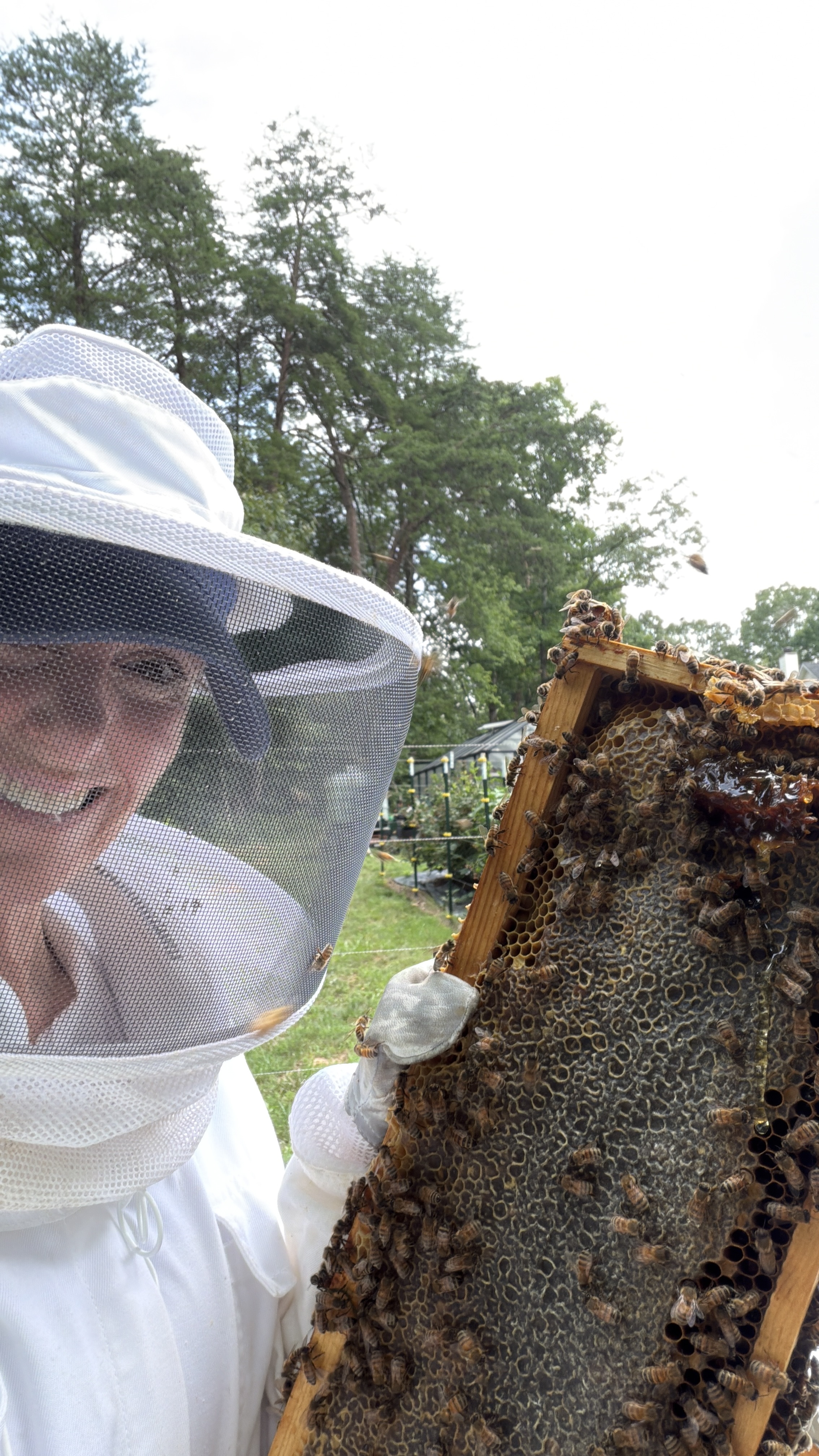
There are some days on the homestead that leave you completely exhausted—but also incredibly grateful. Yesterday was one of those days.
After weeks of waiting for the weather to cooperate, it was finally time for our annual honey harvest. By the end of an eight-hour day, we had six gallons of beautiful, golden honey ready to be filtered and bottled, along with a wonderful supply of beeswax that will eventually become homemade balms and candles.
While the finished jars of honey are what most people see, the journey from hive to honey jar is far more involved than many realize. Here’s a look behind the scenes at what honey harvest day looks like here at J & J Homestead.
Why We Waited Longer to Harvest Our Honey
Normally, we harvest a little earlier in the season. This year, however, Mother Nature had other plans.
Like much of Virginia, we’ve been dealing with an extended stretch of extreme heat. Spending several hours inside a full bee suit while working around active hives simply isn’t safe when temperatures are climbing toward 100°F.
Instead of forcing the harvest, we waited.
Yesterday finally gave us the opportunity we had been hoping for. The skies were overcast, and the high temperature was only a little over 92 degrees. While that still sounds hot—and it certainly was—it was dramatically better than the triple-digit temperatures we’d been experiencing.
Sometimes one of the hardest parts of beekeeping is simply knowing when to wait.
Timing Matters During a Honey Harvest
We began harvesting around 11:00 a.m.
That timing wasn’t random.
By late morning, many of the forager bees have already left the hive in search of nectar and pollen. With fewer bees inside the hive, the harvesting process becomes a little calmer for both the beekeeper and the colony.
The goal is never to disturb the bees more than necessary. Every decision we make during harvest is centered around minimizing stress on the colony while collecting only the surplus honey they’ve produced.
Carefully Choosing Which Honey Frames to Harvest
One thing that surprises people is how slowly the first part of harvesting goes.
Pulling honey frames isn’t simply a matter of opening the hive and grabbing every frame.
Each frame has to be evaluated individually.
We carefully decide which frames are fully capped and ready to harvest while leaving enough resources behind for the colony. Then comes the delicate task of gently removing as many honey bees from each frame as possible before placing it into a cooler.
No matter how many years we do this, this part always takes longer than I expect.

Why We Use Coolers During Honey Harvest
One of the most useful pieces of equipment during harvest isn’t expensive or specialized.
It’s an ordinary cooler.
As each honey frame comes out of the hive, it goes directly into a cooler.
The coolers serve several important purposes:
- They keep the honey frames secure during transport.
- They catch any honey that may drip from the frames.
- Most importantly, they provide a sealed environment that keeps curious honey bees away from the freshly harvested honey.
It makes transporting the harvest back to the house much cleaner—and much less stressful.
A Much-Needed Water Break
By the time the hive work was finished, I was ready for a break.
Working for hours inside a bee suit in the middle of summer is incredibly demanding, even on a “cooler” 92-degree day.
Before the next stage of processing began, I drank what felt like an endless amount of water and Gatorade to replace the fluids lost throughout the morning.
Hydration isn’t optional during honey harvest—it’s absolutely essential.
Bringing the Honey Processing Indoors
Once the honey frames made it back to the house, we moved the rest of the operation into our closed garage.
That serves one very important purpose.
Any bees that happened to follow us home stayed outside.
Processing honey indoors allows us to work without attracting thousands of curious bees to exposed honey.
Before extraction, we removed any remaining bees from the frames and placed each frame into large metal pans. These pans helped organize the frames while also catching every last drop of honey that dripped during the process.
Nothing goes to waste.
Uncapping the Honey
The next step is one of my favorites.
Each honeycomb cell is naturally sealed by the bees with a thin layer of wax known as a cap.
Before the honey can be extracted, those wax caps have to be carefully removed.
Working one frame at a time, we uncapped every frame before placing it into the honey extractor.
It’s a repetitive process, but there’s something incredibly satisfying about seeing the beautiful capped honey revealed underneath.

How a Honey Extractor Works
Once uncapped, the frames are placed into our honey extractor.
Rather than crushing the comb, the extractor spins the frames at high speed using centrifugal force, pulling the honey from the wax comb while leaving the comb itself intact.
The honey flows down the sides of the extractor and collects at the bottom, ready to be filtered before bottling.
One of the greatest advantages of using an extractor is that the bees can reuse the drawn comb, allowing them to spend more time collecting nectar instead of rebuilding wax from scratch.
Nothing Goes to Waste
One of the final steps in our honey harvest is something many people never get to see.
After extraction, we place the empty frames and containers outside for the bees to clean.
Within a surprisingly short amount of time, the bees reclaim every tiny bit of leftover honey.
They also reuse much of the remaining wax as they begin rebuilding and preparing the frames for the next honey flow.
It’s one of my favorite parts of the process because it reminds me just how resourceful honey bees truly are.
Six Gallons of Virginia Honey
By the time everything was cleaned up, washed, and put away, we had spent nearly eight hours harvesting honey.
The reward?
Six gallons of beautiful, local honey produced entirely by our hardworking bees.
We also collected a wonderful supply of beeswax that will eventually become handcrafted balms and candles here on the homestead.
Every jar of honey represents thousands upon thousands of bee flights, countless flowers visited, and months of work by an incredible colony.
It’s impossible not to appreciate that when you’re part of the harvesting process from beginning to end.
Why We Love Beekeeping
Beekeeping is one of the most rewarding—and humbling—parts of our homestead.
The honey is certainly a wonderful reward, but the real value comes from watching healthy colonies thrive while knowing they’re helping pollinate our gardens, fruit trees, berries, flowers, and so many other plants around the homestead.
Harvest day is physically demanding.
It’s hot.
It’s sticky.
It’s exhausting.
But standing there at the end of the day, looking at six gallons of fresh Virginia honey and a table full of golden beeswax, makes every minute worthwhile.
Sometimes the sweetest rewards truly are worth waiting for.


Leave a Reply