
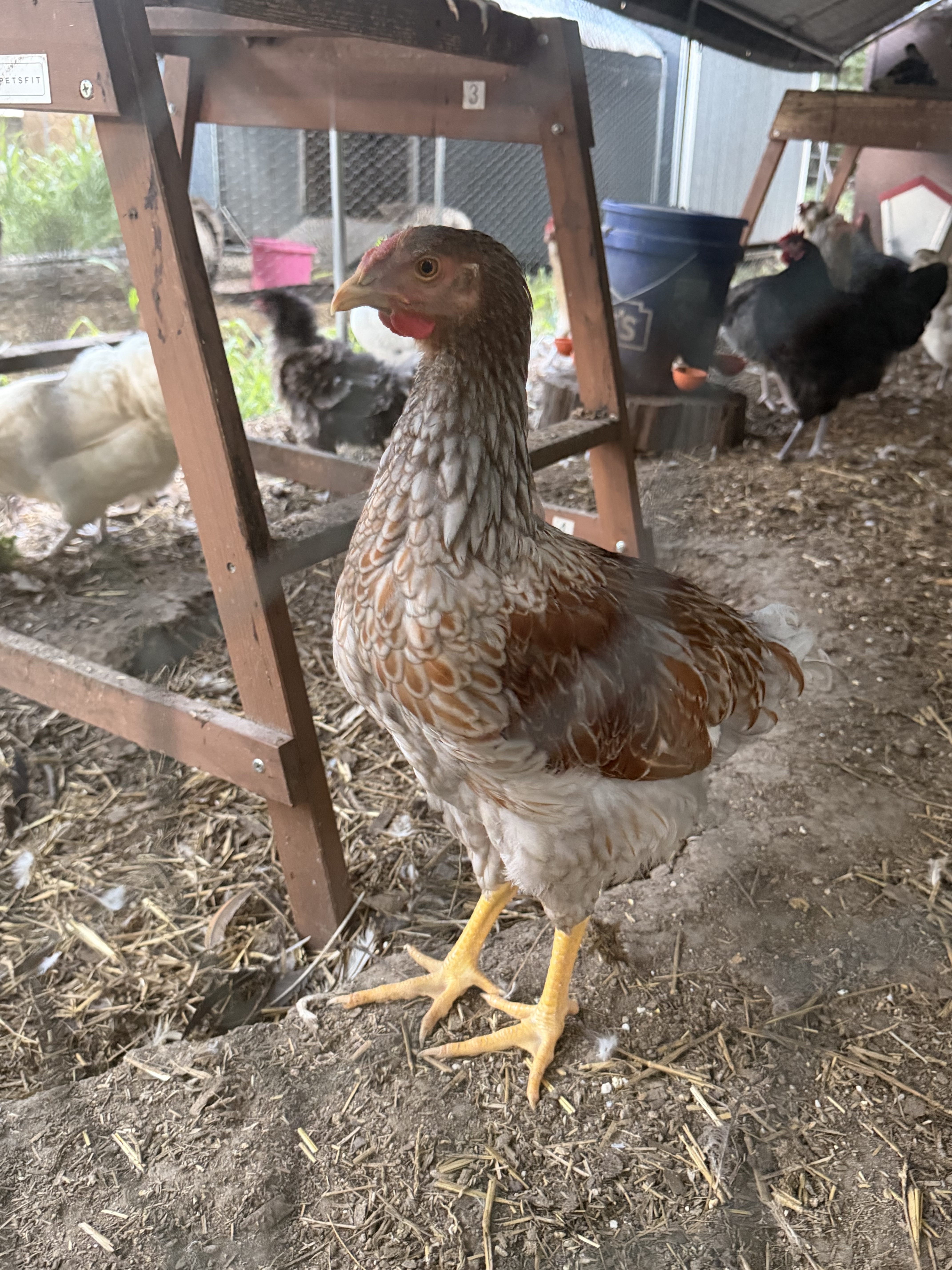
When you have a couple of backyard chickens, tossing some feed into the feeder every morning probably doesn’t feel like a major expense.
When you have over 50 chickens, though? You start paying attention pretty quickly!
Here at J & J Homestead, our flock has grown to a significant number of hens and 6 roosters. Our hens are a mixture of breeds, as well as backyard “blends” and because our chickens don’t free range, everything they eat has to be provided by us.
And lately, we’ve noticed something:
We are going through a LOT of chicken feed.
Between bags of layer feed and scratch grains, it feels like we’re constantly buying more. That got us wondering whether 53 chickens really should be eating that much—or whether we were unintentionally wasting feed and money.
So, we’re making some changes.
How Much Feed Does a Laying Hen Actually Need?
One of the first things we needed to figure out was pretty simple:
How much should a laying hen eat every day?
A good general starting point for an adult laying chicken is approximately 4–6 ounces of complete chicken feed per day.
Of course, that’s not an exact number for every chicken.
Feed consumption varies based on things like:
- Breed and body size
- Age
- Egg production
- Weather and temperature
- Activity level
- Feed quality
- Access to pasture or free-ranging
- Treats and supplemental foods
Our flock contains different breeds and sizes, so we’re not expecting every chicken to eat exactly the same amount. But having a baseline gives us something we desperately needed: A way to measure what we’re actually feeding.
For our 53 chickens, we’re going to start at approximately 16 pounds of complete feed per day. That’s about 4.8 ounces per chicken per day. Instead of continually topping off feeders without really knowing how much feed is disappearing, we’re going to start measuring it.
Our Chicken Feed Problem
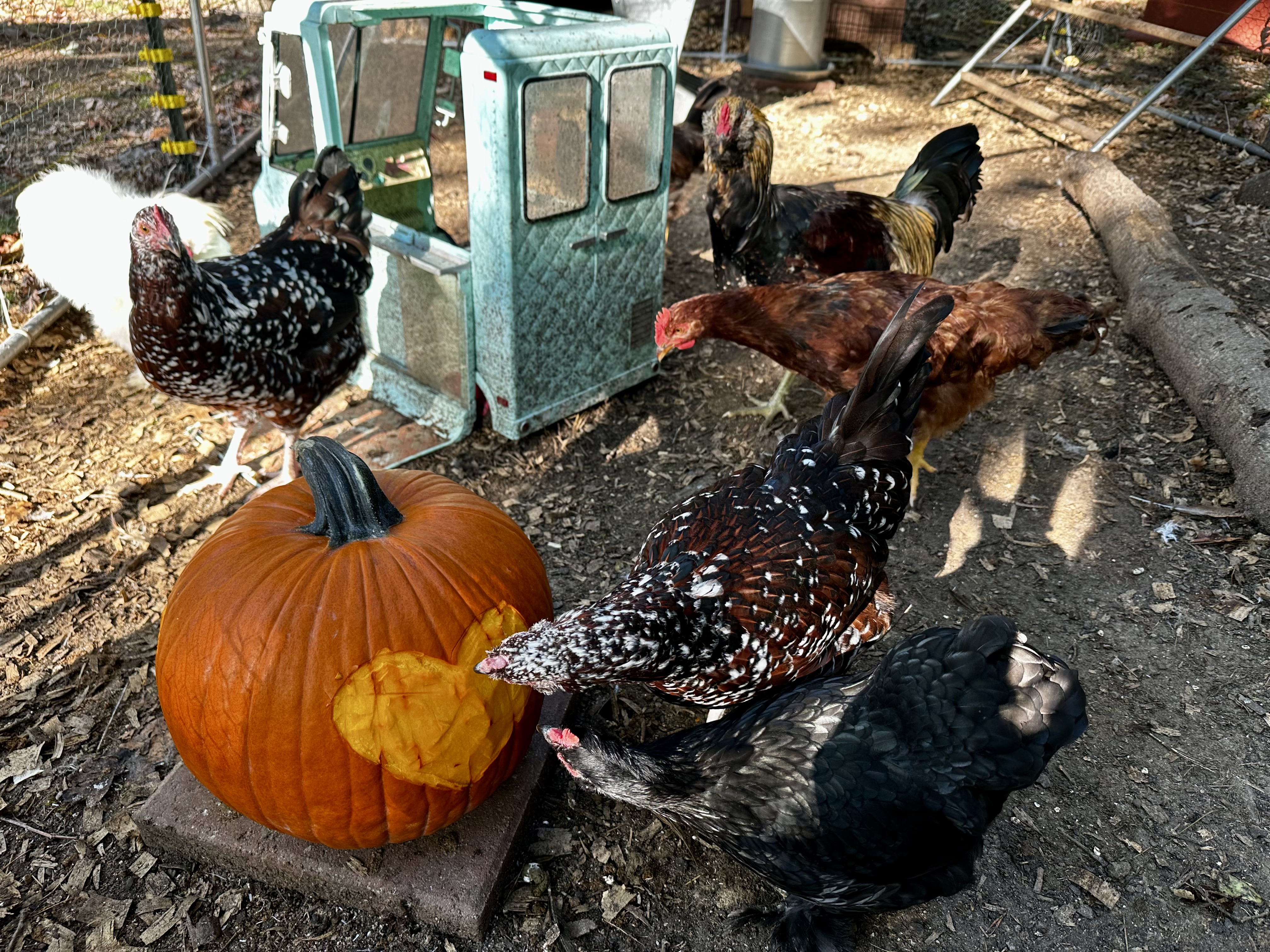
We currently feed our flock Producer’s Pride layer feed from Tractor Supply, along with Producer’s Pride Scratch Grain. And I think this is where we’ve gotten a little off track. Scratch grain is something our chickens absolutely LOVE. If you keep chickens, you know exactly what happens when they hear the scratch container. Suddenly, 53 chickens appear out of nowhere!
Because our chickens don’t free range, we’ve also used scratch as a way to encourage natural scratching and foraging behavior inside their runs. There’s nothing wrong with that. The problem is that scratch grain isn’t supposed to replace complete chicken feed, and I feel that they’ve gotten a little too focused on the scratch grains.
Layer Feed vs. Scratch Grain: There’s a Big Difference
A complete layer ration is designed to provide laying hens with the protein, vitamins, minerals and other nutrients they need for their bodies AND egg production.
Scratch grain is different. Think of scratch as a chicken treat.
It can be wonderful enrichment, particularly for chickens like ours that aren’t able to free range. Scattering scratch encourages them to move around, dig and search for food. But nutritionally, it isn’t a substitute for their regular feed.
Our Producer’s Pride layer ration contains about 16% protein, while the Producer’s Pride Scratch Grain contains approximately 8% protein. That’s a pretty significant difference. If chickens fill up on too much scratch, they’re potentially eating less of the nutritionally balanced feed they actually need.
So we’re changing how we use it.
Our New Feeding Plan for 53 Chickens
We’re not getting rid of scratch. We’re just going to start treating it like what it actually is:
A treat and enrichment tool—not the main course.
Here’s our new starting routine.
Complete Layer Feed: About 16 Pounds Per Day
We’re going to begin by measuring approximately 16 pounds of complete feed each day for our entire flock of 53 chickens.
That works out to roughly:
4.8 ounces per chicken per day
112 pounds per week
480 pounds per 30-day month
That’s just under 10 50-pound bags of layer feed per month.
Those numbers immediately give us something to compare against our actual Tractor Supply purchases. If we’re consistently buying considerably more than 10 bags of layer feed every month, we’ll know something needs investigating.
Scratch Grain: About 1/2–1 Pound Per Day
This is probably going to be our biggest adjustment. Rather than feeding large quantities of scratch, we’re going to really limit it to approximately 1/2 to 1 pound for the entire flock per day.
And instead of putting it in feeders, we’re going to scatter it throughout the chicken runs. That way, we’re getting much more value out of a relatively small amount, and they’re not kicking feed out of the feeders to get to the scratch grain that we’ve mixed with the feed.
The chickens have to walk around, scratch, dig and search for the grain. Essentially, we’re turning their treat into an activity. For chickens that don’t free range, I really like that idea.
We’re Also Transitioning to Layer Pellets
Another change we’re making is moving toward layer pellets instead of crumbles.
Why? Waste.
Chickens are incredibly talented at wasting food. They scratch through feeders. They fling feed onto the ground. They pick through it looking for their favorite pieces. With 53 chickens, even a tiny amount of waste per bird becomes a lot of feed.
Think about this:
If each of our 53 chickens wastes just one ounce of feed per day, that’s more than 3 pounds of feed wasted every single day.
Over a month, that’s approaching 100 pounds of chicken feed.
That’s roughly two entire 50-pound bags of feed potentially ending up on the ground instead of inside our chickens.
Suddenly, paying attention to feeder waste doesn’t seem so silly! Pellets tend to create fewer fines and are harder for chickens to fling around and selectively pick through. We’re hoping that making this relatively simple switch will reduce how much perfectly good feed ends up on the ground.
We’re Raising Our Feeders, Too
We’re also going to take a closer look at our feeder setup. A chicken feeder shouldn’t simply sit on the ground where chickens can easily scratch bedding, dirt and feed everywhere.
We’re going to make sure our feeders are elevated to approximately back height for our adult chickens. The birds can still comfortably reach the food, but it’s harder for them to stand there throwing it everywhere.
For a flock our size, we’re also interested in experimenting with no-waste chicken feeders. Because saving even a few pounds of feed every week adds up quickly over an entire year.
What About Oyster Shell and Grit?
These aren’t going away.
Our chickens will continue having access to oyster shell free choice so laying hens can consume additional calcium when they need it.
We’ll also continue providing poultry grit.
Because our chickens don’t free range, providing appropriate grit is particularly important when they’re eating things other than their complete commercial ration.
What About Feeding Layer Feed to Our Roosters?
This is something else we’re reconsidering. We have six roosters mixed into our flock.
Roosters obviously don’t need the additional calcium required for eggshell production. One option we’re considering is eventually transitioning the mixed flock to a quality all-flock feed, then providing oyster shell separately for the laying hens.
The hens that need additional calcium can consume it free choice, while the roosters aren’t eating a calcium-heavy layer ration every day. We’re going to research this further and see what works best for our particular flock.
We’re Going to Measure Everything for a Week
Rather than guessing whether this works, we’re going to test it.
For at least seven days, we’re going to track:
- How many pounds of complete feed we put out
- How much remains
- How much feed ends up on the ground
- How much scratch we use
- How many eggs we collect
- Whether we notice any changes in flock behavior
We’re starting with approximately 16 pounds of complete feed per day. From there, we’ll adjust. The goal isn’t to restrict food or make our chickens hungry. The goal is to stop wasting it. There’s an important difference.
If our chickens genuinely need more feed, we’ll give them more. But if several pounds are ending up on the ground every day, pouring additional feed into the feeders isn’t solving anything.
The Cost of Feeding 53 Chickens Adds Up
This is the part of homesteading that doesn’t always make it onto Instagram.
Feed is expensive. And when your flock grows gradually, it’s surprisingly easy not to notice how much your feeding habits have changed. One bag becomes two. Two becomes four. Then suddenly it feels like you’re at Tractor Supply every few days loading chicken feed into the truck.
Sound familiar?
That’s exactly why we’re taking a closer look at our system. We’re not necessarily looking for the cheapest way to feed our chickens. We’re looking for the most efficient way to feed them properly. There’s a big difference.
Our Goal: Healthy Chickens Without Wasted Feed
We want healthy birds. We want strong eggshells. We want consistent egg production. We want our chickens to have enrichment and opportunities to engage in natural behaviors. But we don’t want hundreds of dollars worth of perfectly good chicken feed disappearing into the dirt every year.
So our new plan is pretty simple: Measure the complete feed. Reduce the scratch. Use scratch primarily for enrichment. Transition toward pellets. Raise the feeders. Provide oyster shell and grit separately. Track our results.
And then adjust based on what our chickens actually tell us.
Sometimes Homesteading Means Questioning Your Own Routine
This is one of the things I love about homesteading.
You never really stop learning.
We’ve kept chickens for years, but that doesn’t mean we can’t look at something we’ve always done and ask:
Is there a better way to do this?
As our homestead grows, the systems that worked with 10 or 20 chickens aren’t necessarily the systems that make sense with 53 chickens.
And that’s where we are right now.
We’re going to give this new feeding system a try, track the numbers and see exactly how much feed we’re actually using.
I’ll share what we learn—especially whether switching to pellets, reducing scratch and measuring our daily feed actually lowers our monthly Tractor Supply bill.
Because if we can keep 53 chickens healthy and happy while wasting less feed and saving money, that’s a change worth making.

Leave a Reply