
There are certain milestones you expect when you start baking for a farmstand.
The first time you sell out of cookies. The first customer who comes back specifically looking for something you baked. The first time you realize that doubling a recipe isn’t going to cut it anymore and you need to triple it.
And then there are the milestones you never saw coming.
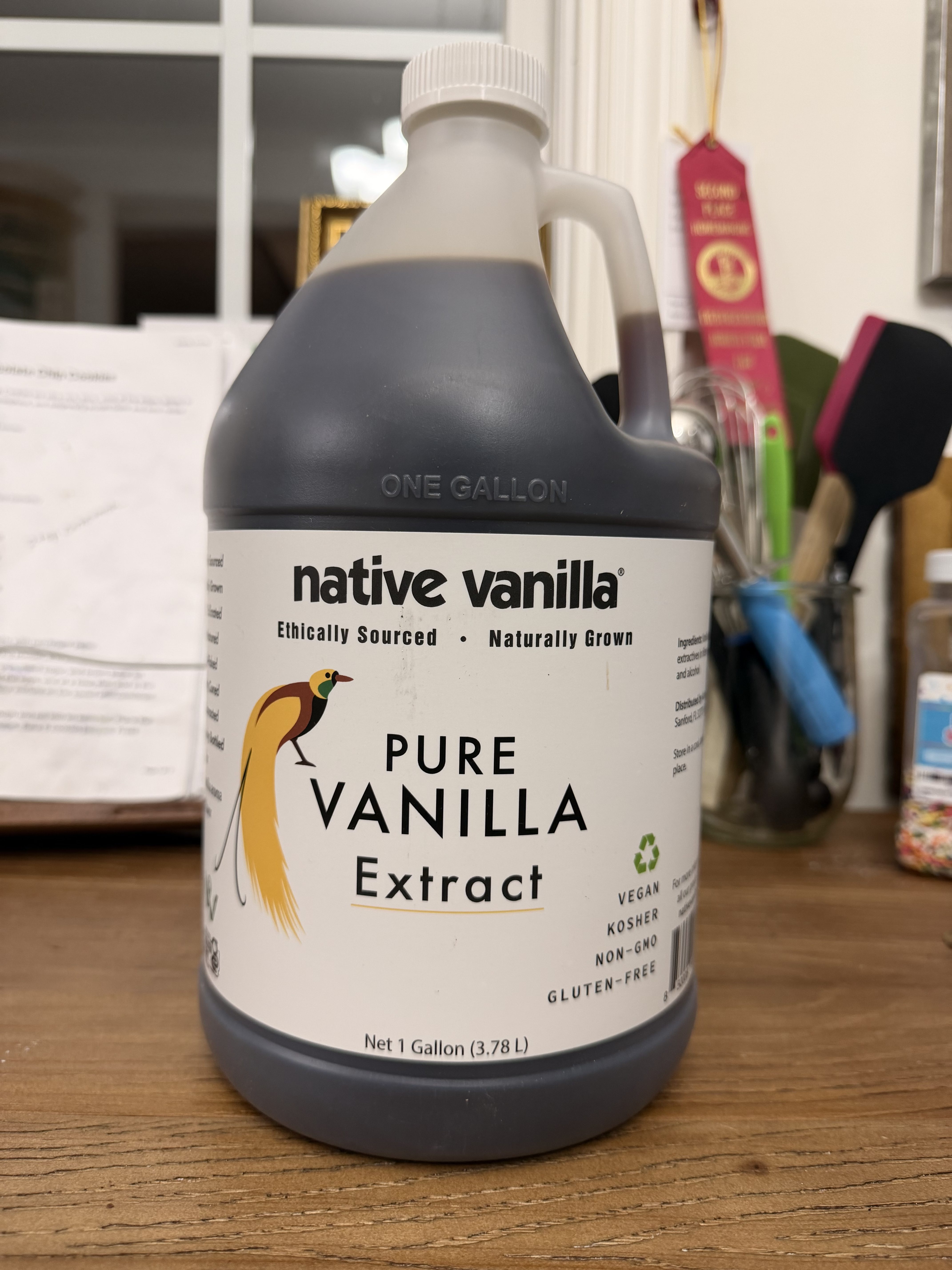
Like the day you buy an entire gallon of vanilla extract. (Native Vanilla)
Yes. A gallon.
I recently took what feels like a surprisingly big step in my farmstand baking journey: instead of grabbing another little bottle of vanilla extract from the grocery store, I bought a full one-gallon container.
At first glance, spending $149 on vanilla might sound slightly ridiculous. But once I started looking at how much vanilla I actually use—and how much those little grocery-store bottles cost—it suddenly made a whole lot of sense.
When You Bake for a Farmstand, Vanilla Disappears FAST
Before we started baking on a larger scale for the J & J Homestead farmstand, vanilla extract was just another ingredient in the pantry.
A bottle lasted quite a while.
That is definitely not the case anymore.
Most of my cookie and baked-good recipes call for at least 2 teaspoons of vanilla extract. But I’m rarely making a single batch of anything.
I’m usually doubling or tripling recipes.
And on a busy baking day, I might make three completely different recipes.
Let’s do some quick math.
If three recipes each call for 2 teaspoons of vanilla and I triple each recipe, that’s:
2 teaspoons × 3 batches × 3 recipes = 18 teaspoons of vanilla
There are 6 teaspoons in a fluid ounce, which means I could use approximately:
3 fluid ounces of vanilla extract in ONE baking day.
Suddenly, those cute little grocery-store bottles don’t seem quite so practical.
The Grocery Store Vanilla Problem
If you only bake occasionally, buying a 2-, 4-, or 8-ounce bottle of vanilla extract makes perfect sense.
But when you’re baking in volume, the cost per ounce becomes much more important than the price printed on the bottle.
For example, imagine paying:
| Bottle Size | Example Price | Cost Per Ounce |
|---|---|---|
| 2 oz | $8.99 | $4.50/oz |
| 4 oz | $14.99 | $3.75/oz |
| 8 oz | $24.99 | $3.12/oz |
| 1 gallon (128 oz) | $149 | $1.16/oz |
Small-bottle prices vary considerably by brand and retailer, but the comparison illustrates why cost per ounce matters.
That gallon of vanilla suddenly doesn’t look so extravagant.
At $149 for 128 fluid ounces, I’m paying approximately $1.16 per ounce.
Compare that with even $3.12 per ounce for an 8-ounce grocery-store bottle.
Buying 128 ounces at that smaller-bottle rate would cost about:
$399.36
My gallon?
$149.
That’s a potential difference of roughly $250.
And compared with some of the smaller bottles, the difference can be even greater.
You Don’t Have to Be a Millionaire to Buy Vanilla by the Gallon!
I think part of what surprised me most was discovering that gallon-size vanilla extract was even an option for a small baker.
Buying ingredients by the gallon sounds like something reserved for commercial bakeries with giant mixers, enormous ovens and employees wearing matching aprons.
Meanwhile, I’m over here baking for our little farmstand.
But that’s exactly why this matters.
You don’t necessarily have to operate a huge commercial bakery to benefit from buying certain ingredients in bulk.
Once you’re consistently doubling and tripling recipes, your purchasing strategy needs to change along with your production.
Instead of asking:
“What’s the cheapest bottle of vanilla?”
I’m starting to ask:
“What’s my cost per ounce?”
That’s a completely different way of looking at ingredients.
What Does Vanilla Actually Cost Per Batch?
Here’s where things get even more interesting.
At $1.16 per fluid ounce, one teaspoon of vanilla costs approximately 19 cents.
So a recipe containing 2 teaspoons of vanilla costs only about:
39 cents in vanilla extract.
Triple that recipe, and I’m using 6 teaspoons—or one fluid ounce—of vanilla.
That’s about $1.16 worth of vanilla for a triple batch.
If I were paying $3.75 per ounce for a smaller bottle, the same triple batch would contain $3.75 worth of vanilla.
That’s a difference of about $2.59 on just one ingredient in one triple batch.
Now repeat that week after week.
That’s when bulk purchasing starts making a very noticeable difference.
Small Savings Matter When You’re Running a Farmstand
This is one of the things I’ve learned as we’ve grown our farmstand.
Profitability isn’t necessarily about making one enormous change.
Sometimes it’s about making dozens of small changes that add up over time.
Saving a couple of dollars on vanilla in a batch of cookies might not sound significant.
But then you save money on flour.
And butter.
And sugar.
And chocolate chips.
And packaging.
And labels.
Suddenly, those seemingly insignificant savings start making a real difference in the cost of producing each item.
And when you’re selling homemade baked goods at a small farmstand, keeping those ingredient costs under control helps us continue offering our customers homemade treats at reasonable prices.
Bulk Buying Doesn’t Always Mean Saving Money
There is an important caveat here.
Bigger isn’t automatically cheaper.
Before buying ingredients in bulk, I think it’s important to calculate three things:
- Cost per unit — ounce, pound, cup, etc.
- How quickly you’ll realistically use the product
- How long it can be stored properly
If I were only using two teaspoons of vanilla every few months, buying 128 ounces wouldn’t make much sense.
But I’m not.
I’m going through vanilla constantly.
That’s the key.
Bulk buying makes the most sense when you’re purchasing something you already use frequently, rather than buying something simply because the larger container appears to be a bargain.
And Just in Time for Holiday Baking!
The timing couldn’t be better.
Fall is arriving, and that means we’re quickly approaching one of my favorite times of year:
holiday baking season.
Cookies.
Breads.
Cakes.
Seasonal treats.
Gift boxes.
And probably more cookies.
Lots and lots of cookies.
Having an entire gallon of vanilla sitting in the pantry means I’m officially prepared.
Or at least prepared as far as vanilla is concerned!
From Grocery-Store Bottles to Gallons
It may seem silly to call buying vanilla extract a milestone.
But I actually think it represents something much bigger.
When we first opened our farmstand, I was baking the way most home bakers bake—buying ingredients in normal grocery-store quantities and replacing them when they ran out.
As the farmstand has grown, I’ve had to start thinking differently.
I’m not just thinking about recipes anymore.
I’m thinking about ingredient costs, batch sizes, efficiency, inventory and cost per finished product.
Buying a gallon of vanilla extract is one tiny example of that evolution.
It’s a $149 purchase that initially made me think:
“Am I really buying a GALLON of vanilla?”
Then I did the math.
Yep.
I’m buying the gallon.
And with holiday baking right around the corner, I have a feeling we’re going to put it to very good use.


Leave a Reply