
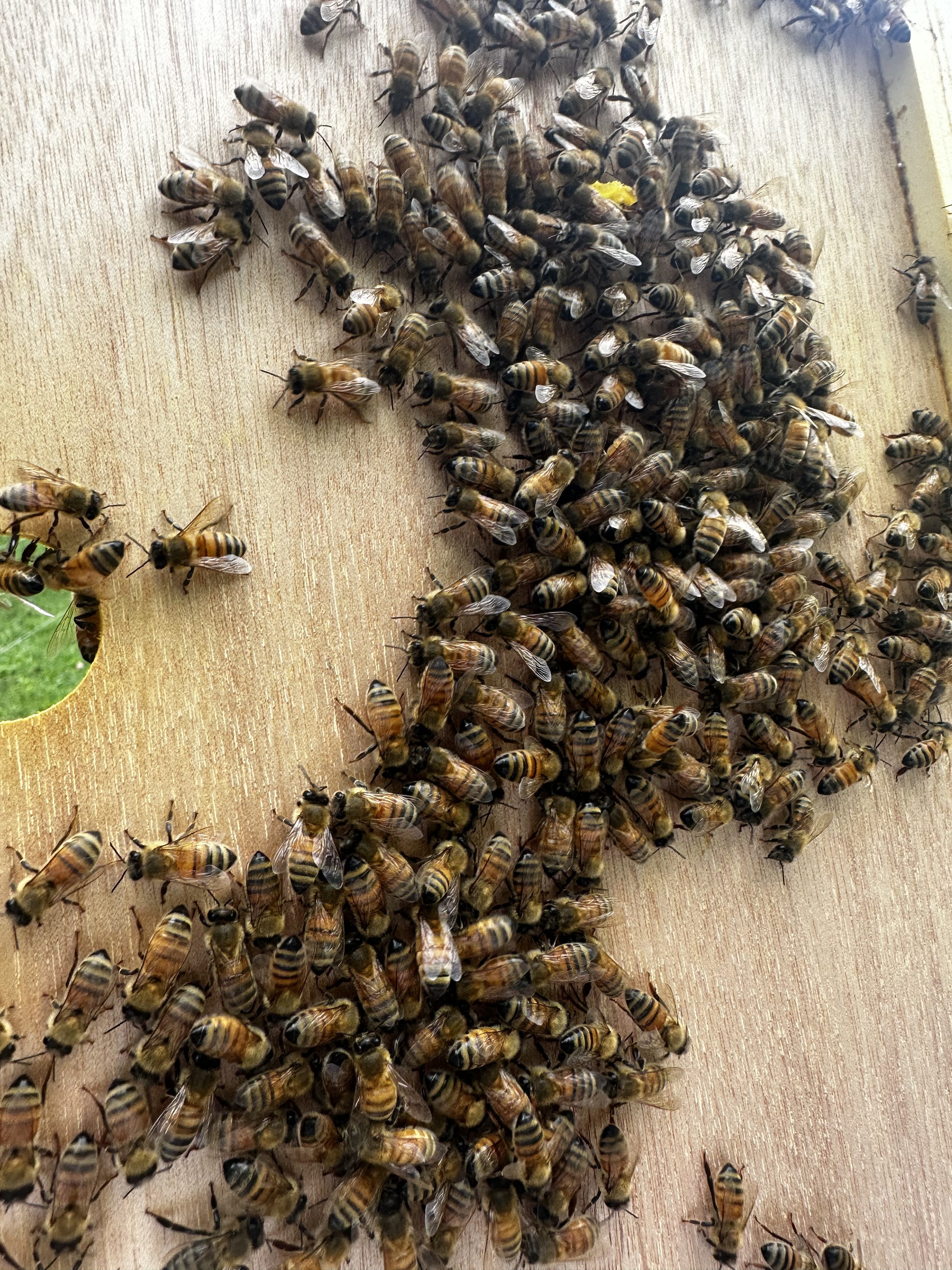
Why moisture, food shortages, Varroa mites, and weak colonies can be more dangerous than freezing temperatures—and what we’re doing at J & J Homestead to prepare our bees for winter.
When most people think about honey bees surviving winter, they imagine one thing: the cold.
After all, honey bees are tiny creatures, and the thought of thousands of them surviving freezing temperatures inside a wooden box seems almost impossible. Surely, the biggest challenge they face must be keeping warm, right?
Well, not exactly!
One of the most fascinating things we’ve learned since starting our beekeeping journey at J & J Homestead is that honey bees are remarkably good at surviving cold temperatures. In fact, a healthy, well-prepared colony can survive temperatures well below freezing without a heater, heat lamp, or any help from us.
But here’s the catch.
Cold weather alone isn’t necessarily what kills honey bee colonies during the winter. More often, it’s a combination of moisture, insufficient food, Varroa mites, and colonies entering winter already weakened.
And after dealing with a struggling hive this year, this is a lesson that has become especially important to us.
As we head into another winter here in Virginia, we’re taking a closer look at how we prepare our bees for the months ahead. This weekend, we’ll be transitioning our winter feeding strategy to the mountain camp method using dry sugar, along with HiveAlive patties, to help give our colonies the resources they need.
But first, let’s talk about what really threatens honey bees during the winter.
1. Moisture: The Hidden Danger Inside a Winter Beehive
You might be surprised to learn that moisture can be more dangerous to a colony than the cold itself.
During the winter, honey bees cluster together inside their hive, forming a tight ball around their queen. The bees generate heat through their flight muscles, allowing them to maintain a warm center even when temperatures outside drop below freezing.
It’s a pretty incredible survival strategy!
But there’s something else happening inside that hive.
As thousands of bees breathe and metabolize their stored honey, they produce water vapor. That warm, humid air rises toward the top of the hive.
If the hive’s ceiling is cold enough, the moisture can condense into water droplets.
And where does that water go?
Unfortunately, it can drip right back onto the bees.
A cluster of bees that becomes wet can lose heat much more quickly, putting the entire colony at risk.
How can beekeepers prevent winter moisture?
There are several ways to help manage moisture inside a winter hive:
- Provide proper ventilation. The hive needs a way for excess moisture to escape without exposing the colony to strong, direct drafts.
- Insulate the top of the hive. An insulated cover can reduce condensation by keeping the surface above the bees warmer.
- Consider a moisture quilt or moisture-management board. These systems can help absorb or manage excess condensation.
- Keep rain and snow out. Make sure covers are secure and the hive is protected from water intrusion.
- Avoid sealing everything shut. A completely airtight hive isn’t necessarily a healthy hive.
The goal isn’t to make the hive warm like our homes. It’s to help the bees maintain their own carefully controlled environment without excessive moisture collecting above them.
Our takeaway: Winter hive preparation isn’t just about keeping cold air out. It’s about keeping the bees dry, too.
2. Starvation: A Colony Can Freeze While Surrounded by Honey
This is one of the saddest realities of winter beekeeping.
A colony can have honey inside the hive and still starve to death.
How is that possible?
During cold weather, honey bees cluster tightly together to conserve energy. As they consume their stored honey, the cluster gradually moves through the hive to access additional food.
However, when temperatures become extremely cold, their ability to move can be limited.
If the cluster runs out of accessible food, the bees may starve even when honey is only a few frames away.
That’s why winter preparation involves more than simply checking whether a hive contains honey. We also need to consider how much food is available and whether the bees can reach it.
How much honey do bees need for winter?
The amount depends on the colony’s size, local climate, hive configuration, and length of winter.
For our region of Virginia, a common planning target is approximately 60 pounds of stored honey for a full-sized colony, although individual needs vary. Mid-Atlantic beekeeping guidance emphasizes ensuring adequate stores before winter begins.
And because winter consumption can be unpredictable, supplemental feeding can provide a valuable backup.
What we’re doing this weekend: The mountain camp feeding method
This weekend, we’ll be transitioning our colonies to the mountain camp method of winter feeding.
If you’ve never heard of it, it’s a simple way to provide bees with dry granulated sugar during the colder months.
Instead of providing liquid sugar syrup, we place dry white granulated sugar on paper above the upper frames, generally using a feeding shim to provide enough space.
A light mist of water can help form a crust on the sugar, while the paper supports it as the bees begin using it.
Why use the mountain camp method?
- It provides an emergency source of carbohydrates above the winter cluster.
- It eliminates the need to feed large quantities of liquid syrup during freezing weather.
- It places supplemental food close to where winter clusters often move as they consume their stores.
- The sugar can absorb some moisture, although it isn’t a substitute for proper ventilation or insulation.
There’s also something very reassuring about knowing that extra food is available if the bees need it.
Of course, dry sugar is supplemental insurance, not a replacement for adequate honey stores. And it works best when the bees can physically reach it.
Our goal is to give the colonies every reasonable opportunity to make it through the winter, especially when food availability becomes harder to predict.
3. Varroa Mites: One of the Biggest Threats Before Winter Even Begins
Of all the challenges beekeepers face, Varroa mites are among the most serious.
These tiny parasites feed on developing and adult honey bees, weakening colonies and transmitting harmful viruses.
What makes them particularly dangerous is their impact on the bees that will carry the colony through winter.
You see, not all honey bees live the same length of time.
During the warmer months, worker bees may live only several weeks because they’re constantly flying, foraging, and working themselves to exhaustion.
But as autumn approaches, colonies begin producing a special generation of longer-lived bees commonly called winter bees.
These bees have greater internal nutrient reserves and are physiologically adapted to survive for months rather than weeks.
They’re essential to keeping the colony alive until spring.
Unfortunately, when Varroa populations are high in late summer and fall, they can damage the very generation of bees the colony depends on for winter survival.
This means a hive might appear reasonably active in September or October but still have serious problems ahead.
By the time winter arrives, the damage may already have been done.
What can beekeepers do about Varroa mites?
The most important strategy is consistent monitoring and timely treatment.
- Monitor mite levels using a reliable method, such as an alcohol wash.
- Use appropriate mite-control treatments when indicated, following product labels and temperature requirements.
- Pay particular attention to mite levels in late summer and early fall.
- Recheck mite levels after treatment to evaluate its effectiveness.
- Continue monitoring throughout the beekeeping season rather than assuming one treatment solves the problem.
An important lesson for new beekeepers is that feeding a colony more sugar won’t solve a Varroa problem.
Healthy nutrition supports the bees, but it cannot replace effective parasite management.
For us, this is another reminder that successfully overwintering bees starts long before the first frost arrives.
4. Weak Colonies: Why Population Matters So Much
This year, we had a particularly important reminder of just how quickly a colony can struggle.
Earlier in the season, we discovered that one of our hives wasn’t doing well.
The colony had weakened, and we eventually found wax moth larvae in the hive.
If you’ve dealt with wax moths before, you know how frustrating this can be.
They can damage comb, leave webbing throughout the hive, and create quite a mess.
But here’s something important we’ve learned:
Wax moths are often a symptom of a struggling colony rather than the original cause of its decline.
Healthy, populous colonies are generally capable of protecting their comb and keeping wax moth populations under control.
When a colony becomes weak, however, there may simply not be enough bees to defend all the available space.
In our case, we suspected that a weak queen may have contributed to the problem.
We can’t say with certainty that this was the only factor, but the experience reinforced something important: a colony’s population and overall health matter tremendously.
Why weak colonies struggle during winter
When winter temperatures drop, bees depend on their cluster to conserve heat.
A large, healthy cluster has more bees available to generate heat, protect the queen, and access food.
A very small cluster has a much harder job.
Even if a weak colony has adequate honey, its population may not be sufficient to maintain the conditions needed for survival.
Weak colonies may also have underlying problems, including queen failure, disease, or high Varroa mite levels.
What our struggling hive taught us
Perhaps the biggest lesson we’ve learned is that we need to pay attention to the entire colony—not just whether we see bees flying in and out of the entrance.
Are we seeing a healthy brood pattern?
Is the queen laying consistently?
Does the colony have enough adult bees to cover and protect its frames?
Are there signs of pests, disease, or nutritional stress?
And perhaps most importantly, are we catching problems early enough to do something about them?
These are questions we’re continuing to ask ourselves as we grow in our beekeeping experience.
Because the truth is, sometimes you can do your best and still lose a colony.
But every experience gives us an opportunity to learn, adjust, and become better beekeepers.
5. Our Winter Feeding Plan: Mountain Camp Sugar and HiveAlive Patties
With November well underway, our attention has shifted from honey production to helping our colonies get through the winter.
This weekend, we’ll be making the transition to our winter feeding strategy.
Our plan includes mountain camp sugar and HiveAlive patties.
Why we’re using HiveAlive patties
HiveAlive offers supplemental feeds, including carbohydrate-rich fondant patties and products containing pollen or protein.
Fondant provides an accessible source of energy when nectar is no longer available and liquid syrup feeding becomes impractical.
Some HiveAlive products also contain seaweed extracts, vitamins, and other supplemental ingredients intended to support bee nutrition. However, these additions shouldn’t be viewed as a proven treatment for disease or a substitute for Varroa control.
For us, it’s about giving the bees another nutritional resource during a season when natural food sources are limited.
There is one important distinction: fondant patties provide carbohydrates, while pollen or protein patties serve a different purpose. Protein supplements can encourage brood rearing, which may increase food consumption and nutritional demands during winter. Their use needs to be timed to the colony’s needs and the local season.
As we prepare the hives, we’ll be paying attention to their food stores, the condition of each colony, and how these different feeding options fit into our winter management.
Why we’re moving away from liquid syrup
During the warmer months, feeding sugar syrup can be an effective way to help colonies build food stores.
But as temperatures drop, liquid feeding becomes more complicated.
Bees need to remove excess moisture from syrup before storing it properly, and cold weather makes that process increasingly difficult.
Dry sugar and fondant are useful cold-weather alternatives because they don’t require the colony to process large amounts of additional water.
That’s particularly important as we think about the moisture challenges that bees already face during winter.
By transitioning our supplemental feeding approach now, we’re hoping to make the colder months a little easier for our colonies.
6. Winter Beekeeping Is About Preparation, Not Constant Intervention
One thing I’ve come to appreciate about beekeeping is that sometimes the best thing we can do is prepare carefully—and then give the bees space to do what they naturally do.
When temperatures are cold, opening a hive unnecessarily can disturb the winter cluster and expose the colony to conditions it’s working hard to manage.
That doesn’t mean we should ignore our hives until spring.
Instead, winter management becomes more about careful observation.
We can monitor the hives’ weight to get a sense of remaining food stores, watch entrances for signs of unusual activity or problems, check that covers remain secure after storms, and replenish supplemental feed when conditions allow.
We can also look for signs of excess moisture without repeatedly pulling the entire hive apart.
Any necessary inspections should be brief and timed for suitable weather.
Our focus is to make sure the bees have what they need while minimizing unnecessary disturbance.
And believe me, sometimes that’s harder than it sounds!
When you’ve invested so much time and energy into caring for your colonies, it’s tempting to want to check on them constantly.
But honey bees have been surviving winters long before we started putting them into wooden hive boxes.
Our job is to help them prepare, manage the threats we’ve introduced or can influence, and support the natural systems that already make them so resilient.
7. What We’re Doing Differently After This Year’s Struggling Hive
If there’s one thing homesteading has taught us, it’s that experience is often the best teacher.
When we started beekeeping in 2024 with two nucleus colonies, we were excited about everything: watching the bees forage, seeing the colonies grow, and eventually harvesting our own honey.
And we’ve had some wonderful successes along the way!
But as with so many parts of homesteading, the challenges can teach us just as much as the successes.
Dealing with our struggling colony this year made us think more carefully about what it really means for a hive to be healthy.
A hive full of honey isn’t necessarily a strong hive.
A colony with lots of bees flying on a warm afternoon isn’t necessarily free of problems.
And simply making it to November doesn’t guarantee that the colony is prepared for January or February.
Moving forward, we’re placing even greater emphasis on monitoring colony strength, paying attention to queen performance, managing Varroa mites, evaluating food stores, and preparing our hives before cold weather sets in.
We’re also learning that every colony is different.
Some colonies are incredibly strong and productive, while others need additional attention.
Sometimes intervention makes sense. Other times, a colony may be too weak to survive independently, and combining it with a healthy, queenright colony may be worth considering if disease is ruled out and conditions permit.
There is no single approach that works for every hive.
But the more we learn, the better equipped we become to make thoughtful decisions.
The Bottom Line: Healthy Bees Survive Winter, Not Just Warm Bees
When we look out at our beehives on a freezing winter morning, it’s easy to worry about how cold the bees must be.
But we’re learning that temperature is only one part of a much bigger picture.
Moisture can compromise the cluster.
Insufficient food can lead to starvation.
Varroa mites can weaken winter bees before cold weather even arrives.
And weak colonies may not have the population needed to survive until spring.
These threats are often connected, which is why successful winter beekeeping requires us to look at the colony as a whole.
This weekend, as we transition to mountain camp sugar and HiveAlive patties, we’ll be thinking about everything we’ve learned this year—including the struggles.
Our goal isn’t to eliminate every possible risk. That’s simply not realistic in homesteading or beekeeping.
Our goal is to give our honey bees the best possible chance to emerge healthy and strong when the spring flowers begin blooming again.
Because there’s something truly wonderful about walking out to the hives on that first warm spring day and seeing bees flying, collecting pollen, and getting back to work.
And after a long winter, that sight makes all the preparation worthwhile.
Here’s to healthy bees, strong colonies, and another season of learning together!
Happy homesteading!
Leave a Reply