
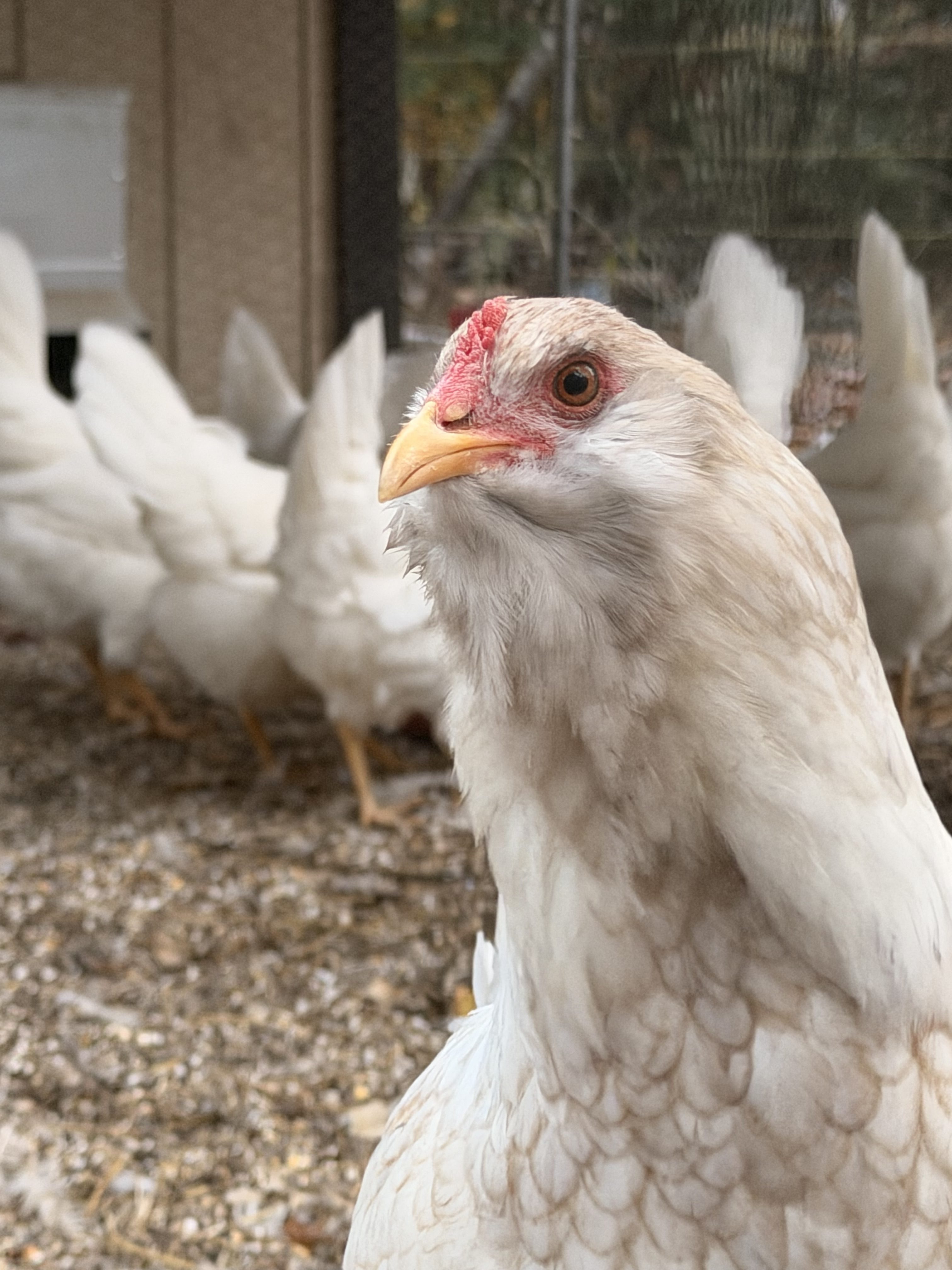
Most chickens can handle cold winter temperatures surprisingly well. But what happens when you have older chickens or breeds that need a little extra help? Here’s why we heat one of our four chicken coops during the coldest winter nights—and why we leave the others unheated.
If you’ve been raising backyard chickens for any length of time, you’ve probably encountered one of the biggest debates in winter chicken care: Should you heat your chicken coop?
Some chicken keepers wouldn’t dream of leaving their coops without supplemental heat. Others firmly believe that chickens should never have artificial heat during the winter.
Here at J & J Homestead, we fall somewhere in the middle.
We believe that chickens are remarkably resilient animals, and most healthy, fully feathered chickens are perfectly capable of handling cold temperatures when they have a properly maintained coop.
But we also believe that not every chicken has the same needs.
We currently have four different chicken flocks, each with its own coop and run. And of those four coops, we only provide supplemental heat to one.
Why?
Because sometimes good animal husbandry means recognizing that what works for most of your flock might not work for every bird.
And that’s exactly what we’re talking about today!
Do Chickens Really Need Heat in the Winter?
The short answer? Usually, no!
Chickens are surprisingly well-equipped to handle winter weather. Their feathers provide an incredible amount of insulation, trapping pockets of warm air close to their bodies.
You’ve probably noticed your chickens fluffing up their feathers on cold mornings. That isn’t just because they’re trying to look adorable (although they certainly succeed!). They’re actually creating additional insulation to help conserve body heat.
Chickens also have several natural advantages when temperatures drop:
- Insulating feathers: Their feathers trap warm air, helping protect them from the cold.
- High body temperatures: Chickens naturally maintain body temperatures around 105°F–107°F.
- Communal roosting: Chickens often roost close together, helping conserve warmth.
- Cold-weather acclimation: Healthy chickens gradually adjust to falling temperatures as autumn transitions into winter.
For most healthy adult chickens, a dry, well-ventilated coop that protects them from harsh drafts is far more important than keeping the coop warm.
And for three of our four flocks, that’s exactly the approach we take.
Why We Heat Only One of Our Four Chicken Coops
Here’s where our philosophy becomes a little more individualized.
At J & J Homestead, we don’t treat all four of our chicken flocks exactly the same.
Each flock has its own personality, breed characteristics, ages, and physical needs.
One of our flocks consists primarily of older chickens, along with breeds that may not be as well-suited to extremely cold weather.
As chickens age, some become less resilient when dealing with environmental stress. An older chicken that has difficulty maintaining its body condition, has health challenges, or is simply more vulnerable to the cold may benefit from additional protection.
Breed characteristics also make a difference.
Some chickens have large bodies and thick, dense feathering that help them tolerate cold weather exceptionally well. Others, particularly certain smaller or more delicate breeds, may have a harder time staying comfortable during extreme temperatures.
Even the University of Maryland Extension points out that smaller birds, including bantams, may have different heating needs than larger chickens. University of Maryland Extension
For us, that means taking a closer look at the chickens themselves rather than applying one rule to every coop.
When temperatures are expected to dip below 15°F, we provide supplemental heat to our older, more vulnerable flock.
Now, 15°F isn’t a magical temperature at which chickens suddenly become unsafe. It’s simply the temperature we’ve chosen as our practical threshold for giving this particular flock additional support.
We also pay attention to how the birds are behaving, their physical condition, and how cold it actually gets inside their coop.
Our other three flocks continue without supplemental heat because their individual needs and conditions don’t currently warrant it.
And that’s an important distinction.
Our goal isn’t to create a warm, cozy living room for our chickens. It’s to help protect our more vulnerable birds during periods of extreme cold.
The Chicken Coop Heater We Use at J&J Homestead
A J & J Homestead, we’ve been using the Briidea Dog House Heater, which can double as a chicken coop heater. We chose this heater primarily because of its wall-mounted design, adjustable temperature controls, and dust protection.
One of the challenges we faced when selecting a heater was the design of our coop.
The particular coop that houses our older chickens has a very high roof. This makes traditional suspended heating options impractical for our setup.
We needed something that could be mounted securely to a wall, wouldn’t take up valuable floor space, and would allow us to control the temperature without constantly checking and manually operating the heater.
The Briidea 400W Chicken Coop Heater offered several features that appealed to us.
1. Wall-Mounted Heating Makes Sense for Our Coop
This was one of the biggest selling points!
With our high coop ceiling, suspended heaters simply weren’t a practical option.
The Briidea heater attaches directly to the wall, keeping it out of the way of everyday chicken activity.
And if you’ve ever spent any time around chickens, you know they are curious creatures. If something can be pecked, scratched, climbed on, or knocked over, chances are a chicken will eventually try!
Having a securely mounted heater helps reduce some of those concerns.
Of course, mounting a heater doesn’t eliminate fire risks. It’s still essential to follow the manufacturer’s clearance requirements and ensure the unit and electrical components are properly installed.
2. Adjustable Temperature Controls
Another feature that appealed to us is the heater’s adjustable temperature control.
According to Briidea, the unit allows temperatures to be selected between 32°F and 122°F using an LCD display.
The heater also uses automatic temperature sensing to cycle on and off in response to its settings.
This is particularly helpful because we aren’t trying to keep our chicken coop at indoor household temperatures!
We simply want to provide a little additional warmth when conditions become especially harsh.
Having adjustable controls allows us to be more intentional about how much supplemental heat we’re providing.
One important detail: the manufacturer’s adjustable range describes the heater’s settings, not the temperature that every coop will achieve. Actual results depend on coop size, insulation, ventilation, and outdoor conditions. We always recommend monitoring the temperature independently near the chickens’ roosting area.
3. The Dust Protection Is a Huge Bonus!
Can we talk about chicken coop dust for a moment?
Because if you know, you KNOW!
No matter how frequently we clean our coops, dust seems to be a never-ending battle.
Between bedding materials, feathers, feed particles, and everyday chicken activity, it’s amazing how quickly dust accumulates.
One of the features I especially appreciate about this heater is its removable magnetic metal dust filters.
These are intended to help keep feathers, dust, and other debris out of the heater’s fans.
And anything that makes cleaning and maintaining equipment inside a chicken coop easier is a win in my book!
Of course, those filters still need to be inspected and cleaned regularly. Dust buildup around electrical heating equipment is something we never want to ignore.
4. Quiet Operation and Less Nighttime Disturbance
Chickens need their rest just like the rest of us.
We’ve used heaters previously that were disturbingly loud (I was scared that they were having an issue and would start a fire – those resulted in many nights of poor sleep!). The Briidea heater is designed to operate quietly, and its LCD display automatically turns off after approximately 30 seconds.
We appreciate this because we don’t want unnecessary light or noise disrupting the flock throughout the night.
Maintaining a consistent nighttime routine is an important part of keeping our chickens comfortable and reducing stress.
5. A Protected Power Cord
The heater also comes with an 11.5-foot anti-chew cord, which provides flexibility when positioning the unit inside the coop.
Briidea describes the cord as UL-certified.
That said, a protected power cord is not a substitute for good electrical safety. We still believe cords should be routed where chickens cannot reach them and electrical connections should be protected from moisture and damage.
The product is advertised for enclosed spaces up to 120 cubic feet, so checking the actual interior volume of your coop is important before selecting a heating device. briidea
Why We Don’t Heat All Four Chicken Coops
You might be wondering: If supplemental heating can help one flock, why not provide it to all four?
It’s a fair question!
For us, the answer comes down to three important considerations.
First, our other chickens don’t need it.
Most of our healthy adult birds are perfectly capable of maintaining their body temperatures through our Virginia winters, provided their coops remain dry, well-ventilated, and protected from drafts.
Second, supplemental heat comes with risks.
Any electrical heating equipment introduces an additional potential fire hazard, especially in an environment filled with dry bedding, feathers, and dust.
Adding heaters unnecessarily would introduce risks without providing a clear benefit to those birds.
Third, we want our chickens to acclimate naturally to seasonal changes.
We don’t want to create unnecessary dependence on artificially warm conditions. Gradual acclimation helps chickens adapt to their environment, and an abrupt loss of supplemental heat can be especially problematic for birds accustomed to warmer housing.
Instead, we focus our attention on providing the best possible winter housing conditions.
That means preparing the coops before temperatures begin dropping, maintaining good ventilation, managing moisture, providing appropriate nutrition, and keeping drinking water available.
Heating is an additional tool in our winter care routine—not a replacement for good chicken management.
If You Decide to Heat Your Chicken Coop, Safety Comes First
This is probably the most important part of today’s conversation.
Heating chicken coops is not without risk, and we would never recommend simply plugging in an electrical heater without carefully considering its installation.
Before installing any supplemental heater, we recommend taking the following precautions:
- Use only equipment specifically approved by the manufacturer for your intended coop environment. Confirm the unit’s clearance, mounting, electrical, and ventilation requirements.
- Keep heaters away from flammable materials. Bedding, straw, wood shavings, feathers, and accumulated dust can all create hazards.
- Secure electrical wiring. Keep cords away from curious beaks, moisture, and areas where birds may scratch or roost.
- Avoid improvised electrical connections. Use properly installed, protected electrical outlets and follow the manufacturer’s directions regarding extension cords.
- Maintain ventilation. A heated coop still needs adequate airflow to remove excess moisture and ammonia.
- Regularly inspect and clean equipment. Check filters, cords, mounting hardware, and surrounding areas for dust or damage.
- Prepare for power outages. Have a plan to keep vulnerable birds safe if the heater stops working during severe winter weather.
A heater should never give us a false sense of security. We still need to inspect the coop and observe our birds regularly.
Don’t Forget: Moisture Can Be More Dangerous Than Cold
Here’s another important reminder for anyone preparing their chicken coops for winter.
One of the biggest mistakes chicken keepers can make is sealing their coops so tightly that moisture has nowhere to escape.
It might seem logical to close every little opening to keep warm air inside.
But chickens produce moisture through breathing and droppings. Without sufficient ventilation, that moisture can accumulate inside the coop.
When cold temperatures and excessive moisture combine, the risk of frostbite can increase significantly.
Poor ventilation also allows ammonia from droppings to build up, potentially irritating chickens’ respiratory systems.
This is why we place so much emphasis on keeping our coops dry, properly ventilated, and protected from direct drafts.
A dry, cold coop is generally healthier than a damp, poorly ventilated warm coop.
Even in our one heated coop, maintaining airflow remains a priority.
How Do You Know If Your Chickens Are Too Cold?
This is another reason we believe in watching our chickens rather than relying exclusively on a thermometer.
While some feather fluffing and huddling are perfectly normal winter behaviors, there are other signs that may indicate a chicken is struggling with the cold.
We pay particular attention to chickens that appear unusually lethargic, remain persistently huddled, stop eating or drinking normally, show reduced activity, or seem unable to warm themselves.
We also keep an eye out for discoloration or other changes to combs and wattles that could suggest frostbite.
An older chicken that is losing weight or struggling to maintain normal activity deserves extra attention, regardless of the outdoor temperature.
And if a bird is weak, unable to stand, or showing signs of serious cold stress, simply turning up a coop heater isn’t enough. That chicken may need to be moved to a safe, warmer recovery area and evaluated for illness or injury.
Remember, every flock is different!
Our Winter Chicken Care Philosophy: Give Them What They Need, Not Necessarily What We Think They Want
One of the lessons we’ve learned over the years at J&J Homestead is that good homesteading isn’t always about following a universal rule.
It’s about learning your animals, understanding their individual needs, and making thoughtful decisions based on what you observe.
For our four chicken flocks, that means three coops without supplemental heat and one coop where we provide additional warmth when temperatures become extremely cold.
We don’t heat that coop because we believe every chicken needs to be warm all winter.
We heat it because we have an older, more vulnerable group of chickens that may benefit from a little additional help when temperatures dip below 15°F.
And for us, the Briidea Chicken Coop Heater provides features that fit our particular coop design and approach to controlled heating.
But regardless of whether you heat your coop, the fundamentals remain the same: dry bedding, proper ventilation, good nutrition, fresh water, protection from drafts, and close attention to your birds.
Because at the end of the day, the best winter chicken care isn’t about keeping every coop warm. It’s about keeping every flock healthy.
And sometimes that means giving a few of our older girls a little extra help through the coldest nights.
That’s simply part of caring for the animals that make our homestead such a special place.


Leave a Reply